50 Interesting Facts About China: Language, History, Food, and Daily Life
 沉浸 TeamSeptember 3, 202613 min read
Looking for interesting facts about China? Here are 50 of them, grouped so you can jump straight to what you care about: the language, the history, the food, the geography, and everyday life in modern China. Every fact is one or two sentences, and the first ten are the ones almost everyone should know.
China is home to around 1.4 billion people, a written language that's over 3,000 years old, and a modern economy where most people haven't touched cash in years. It's a country of contrasts, and that's what makes these facts fun. Our Chinese culture hub has the fuller picture on values, customs, and festivals; this article is the quick tour.
10 facts about China everyone should know
If you only read one section, make it this one. These are the ten "China fun facts" that come up again and again.
- 1. Mandarin has more native speakers than any other language on Earth. Around 900 million people grow up speaking it, and hundreds of millions more learn it as a second language at school. Its official name is 普通话 (Pǔtōnghuà, "common speech").
- 2. Chinese has no alphabet. It's written with characters, and each one stands for a syllable and a meaning rather than a single sound. We explain how that works in Is there a Chinese alphabet?
- 3. A big dictionary lists more than 50,000 characters, but about 3,000 cover daily reading. Most educated adults know somewhere around 4,000 to 5,000. Read how many Chinese characters there are for the full breakdown.
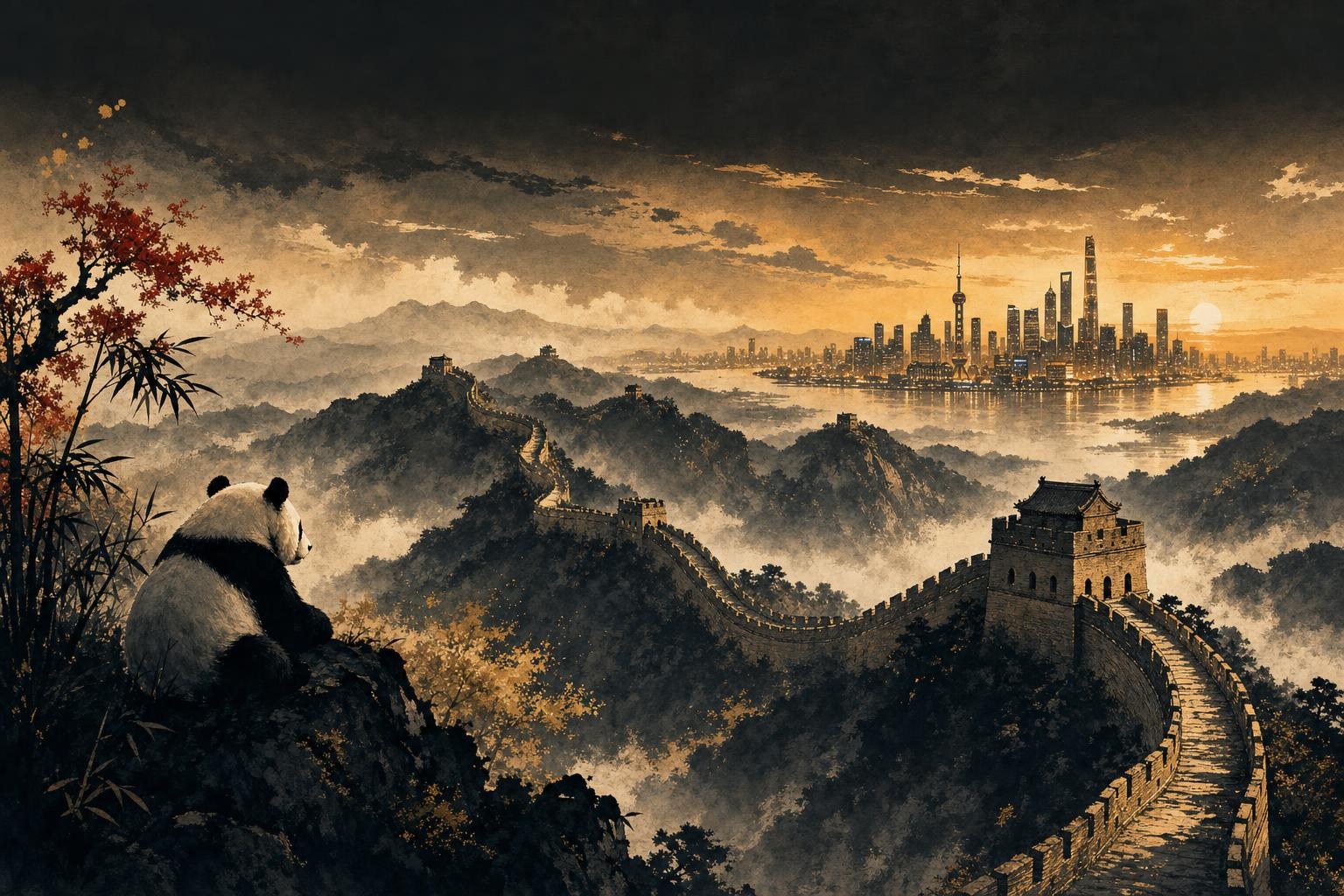
- 4. You can't see the Great Wall from space with the naked eye. The 长城 (Chángchéng, "Great Wall") is very long, but it's only a few meters wide and the same color as the land around it. Astronauts have said so repeatedly.
- 5. The whole country runs on one time zone. China is wide enough to cover about five geographic time zones, but everyone uses Beijing time. In the far west, the sun can rise after 9 a.m. in winter.
- 6. China officially recognizes 56 ethnic groups. The Han make up around 91% of the population, and the other 55 groups (Zhuang, Uyghur, Hui, Tibetan, Mongol, and more) have their own languages, foods, and festivals. The word for ethnic group is 民族 (mínzú).
- 7. Paper, printing, gunpowder, and the compass were all invented in China. These are known as the Four Great Inventions, and each one changed the world. Our guide to Chinese inventions covers those four plus a lot you may not expect.
- 8. Giant pandas live in the wild only in China. The 熊猫 (xióngmāo, "panda") is found in the mountain forests of Sichuan and a couple of neighboring provinces, and nowhere else on Earth outside a zoo.
- 9. Chinese New Year travel is the largest annual human migration. In the weeks around the festival, people make billions of trips home to see family. The travel season even has its own name, 春运 (chūnyùn). Read more in our guide to Chinese New Year.
- 10. China has the biggest high-speed rail network in the world. Over 40,000 kilometers of track carry trains at up to 350 km/h, more than the rest of the world combined. The trains are called 高铁 (gāotiě, "high-speed rail").
Fun facts about China's language and writing
This is the part we know best at Chenjin, so we'll go a little deeper. If you're learning Chinese, these are the facts that will make the language click.
- 11. Tones change the meaning of a word. Mandarin has four tones plus a neutral one. 妈 (mā, "mother") and 马 (mǎ, "horse") are the same sounds with a different pitch. Our guide to Chinese tones shows you how to hear the difference.
- 12. There's one written language but many spoken ones. Mandarin, Cantonese, Shanghainese, and Hokkien can be as different as Spanish and Italian when spoken, yet they share the same characters on paper. See Chinese dialects for the map.
- 13. Chinese verbs never conjugate. 吃 (chī, "eat") is the same word whether it's I, you, or they, and whether it's today or last year. Time words and particles do the job instead. Details in our Chinese grammar hub.
- 14. Nouns don't have plurals, but you need measure words. You can't say "three books"; you say "three volume book," 三本书 (sān běn shū), using the classifier 本 (běn). Our measure words guide lists the ones you need.
- 15. Pinyin is how Chinese people type. 拼音 (pīnyīn) is the official system for writing Chinese sounds in Latin letters, adopted in 1958. Type "nihao" on a phone and the characters 你好 pop up. Try it with our Chinese to pinyin converter.
- 16. There are two sets of characters in use today. Mainland China and Singapore use simplified characters; Taiwan, Hong Kong, and Macau use traditional. 马 and 馬 are the same word. Here's simplified vs traditional explained.
- 17. Around 100 million people share the surname Wang, and about the same number share Li. 王 (Wáng, "king") and 李 (Lǐ, "plum") are each more common than the entire population of Germany. Read about the 100 common Chinese surnames.
- 18. The family name comes first. A person called 李小明 is Mr. Li, not Mr. Xiaoming. The surname is one character and the given name is usually one or two. Our explainer on how Chinese names work has more.
- 19. Characters are built from smaller pieces called radicals. The water radical 氵 shows up in 河 (hé, "river"), 海 (hǎi, "sea"), and 湖 (hú, "lake"). Once you know around 100 radicals, new characters stop looking random.
- 20. Chinese has thousands of four-character idioms. A 成语 (chéngyǔ) packs a whole story into four characters, like 画蛇添足 (huà shé tiān zú, "draw a snake and add feet," meaning to ruin something by overdoing it). We collected our favorites in the chengyu guide.
Cool facts about China's history
China's history runs so long that "ancient" and "old" mean different things there. A 500-year-old building is fairly recent.
- 21. Chinese writing is over 3,000 years old, and people can still read it. The oldest known characters are 甲骨文 (jiǎgǔwén, "oracle bone script"), carved into turtle shells and ox bones during the Shang dynasty. Many of them are recognizable ancestors of characters used today.
- 22. The Terracotta Army was found by farmers digging a well. In 1974, villagers near Xi'an struck clay and uncovered the 兵马俑 (bīngmǎyǒng), thousands of life-size soldiers buried with the first emperor, Qin Shi Huang, around 210 BC. No two faces are the same.
- 23. The Forbidden City is said to have 9,999 rooms. The story goes that only heaven could have 10,000, so the emperor stopped one short. The real count is lower, but the 故宫 (Gùgōng, "Forbidden City") in Beijing is still the largest palace complex in the world.
- 24. China ran a civil service exam for about 1,300 years. The 科举 (kējǔ) tested men on the classics, and passing it could lift a farmer's son into government. It started in the Sui dynasty and ended in 1905.
- 25. Silk was a Chinese secret for centuries. 丝绸 (sīchóu, "silk") was so valuable that the trade routes to Europe were named after it, and smuggling silkworms out of China was said to be punishable by death.
- 26. China used paper money hundreds of years before Europe. Merchants in the Song dynasty were trading paper notes around the 11th century, while Europe didn't print banknotes until the 1600s.
- 27. The Grand Canal is the longest man-made waterway on Earth. The 运河 (yùnhé, "canal") runs around 1,800 kilometers from Beijing to Hangzhou, and parts of it are more than 2,000 years old. Boats still use it.
- 28. Confucius was born around 551 BC, and his ideas still shape daily life. 孔子 (Kǒngzǐ) taught respect for elders, education, and good manners, values you can still see in how Chinese families work today. He's one of the names in our list of famous Chinese people.
Interesting things about China's geography and records
- 29. China is one of the largest countries in the world. At about 9.6 million square kilometers, it's roughly the same size as the United States, and depending on how you count coastlines and territory, it ranks third or fourth by area.
- 30. China borders 14 countries. That ties it with Russia for the most land neighbors of any country: from North Korea in the east to Afghanistan and Pakistan in the west, and India, Nepal, and Vietnam in the south.
- 31. The world's highest mountain sits on China's border. Mount Everest, called 珠穆朗玛峰 (Zhūmùlǎngmǎ Fēng) in Chinese, straddles the line between Tibet and Nepal. Its north face is on the Chinese side.
- 32. The Yangtze is the longest river in Asia. The 长江 (Cháng Jiāng, literally "long river") flows around 6,300 kilometers from the Tibetan Plateau to Shanghai. Only the Nile and the Amazon are longer.
- 33. China was the most populous country for decades, and India only passed it around 2023. Both countries have around 1.4 billion people. China's population has now started to shrink slightly.
- 34. Shanghai is one of the most populous cities on the planet. 上海 (Shànghǎi) has over 24 million residents, and China has more than 100 cities with a population above one million.
- 35. The Three Gorges Dam is the biggest power station in the world. Built across the Yangtze, 三峡 (Sānxiá) generates more electricity than any other single plant on Earth.
Fun facts about Chinese food and drink
Food is a huge part of Chinese life. A common greeting between friends is 你吃了吗 (nǐ chī le ma), "have you eaten?"
- 36. China was drinking tea thousands of years before Europe. 茶 (chá, "tea") shows up in Chinese records more than 2,000 years ago, and the English word "tea" and the word "chai" both trace back to Chinese. Our guide to Chinese tea covers the six main types.
- 37. Fortune cookies aren't Chinese. They were popularized in California in the early 1900s, likely from a Japanese recipe. Most people in China have never seen one.
- 38. Chopsticks are over 3,000 years old. 筷子 (kuàizi, "chopsticks") began as cooking tools for reaching into hot pots and became everyday eating utensils around 2,000 years ago. Never stick them upright in a bowl of rice; it looks like incense at a funeral.
- 39. Hot water is the default drink. Ask for water at a restaurant and you'll often get it steaming. 热水 (rèshuǐ, "hot water") is considered good for your health, and many people carry a thermos everywhere.
- 40. Birthdays mean long noodles, not always cake. 长寿面 (chángshòumiàn, "longevity noodles") are served in one long strand, and you're not supposed to cut them, since that would cut your life short. Learn the birthday song in happy birthday in Chinese.
- 41. There's no such thing as one "Chinese food." China traditionally counts eight great regional cuisines. Sichuan food is famous for 麻辣 (málà, "numbing and spicy"), while Cantonese cooking is mild and steamed. For the street-food side, see Chinese snacks.
- 42. Mooncakes are eaten under the full moon once a year. A 月饼 (yuèbing, "mooncake") is a dense pastry with sweet bean or lotus-seed filling, shared with family during the Mid-Autumn Festival.
Interesting facts about daily life and modern China
- 43. The number 4 is avoided and 8 is lucky. 四 (sì, "four") sounds like 死 (sǐ, "death"), so buildings sometimes skip the fourth floor. 八 (bā, "eight") sounds like 发 (fā, "get rich"), which is why the Beijing Olympics opened on 8/8/2008 at 8:08 p.m. More in Chinese numbers 1-10.
- 44. Red means luck, so it's everywhere. 红 (hóng, "red") shows up in wedding dresses, New Year decorations, and the red envelopes stuffed with cash. White, on the other hand, is the color of funerals. See Chinese colors and their meanings.
- 45. The Chinese zodiac repeats every 12 years. Each year gets one of 12 animals, so your 生肖 (shēngxiào, "zodiac sign") depends on your birth year, not your birth month. Find yours in our Chinese zodiac guide.
- 46. Chinese dragons are lucky, not evil. Unlike the fire-breathing monsters of Western stories, the 龙 (lóng, "dragon") brings rain, power, and good fortune. Parents hope for a baby in the Year of the Dragon. Read about the Chinese dragon and what it means.
- 47. Table tennis is the national sport. 乒乓球 (pīngpāngqiú, "ping-pong") tables sit in parks, schools, and office courtyards, and China has won the large majority of Olympic table tennis gold medals ever awarded.
- 48. Traditionally, you're already one year old when you're born. In the old counting system, called 虚岁 (xūsuì), a baby is one at birth and everyone gets a year older at Chinese New Year, not on their birthday. Many older people still count this way.
- 49. Every evening, public squares fill up with dancers. 广场舞 (guǎngchǎngwǔ, "square dancing") is a hugely popular group exercise, mostly among retired women, who dance to music from a portable speaker in parks and plazas across the country.
- 50. Almost nobody uses cash. People pay for everything from taxis to street snacks by scanning a QR code with their phone. The verb is 扫码 (sǎomǎ, "scan the code"), and even street musicians display one for tips.
The most interesting fact of all
Out of all 50, the one that sticks with most people is the language. A writing system with no alphabet, over 3,000 years old, that a billion people use to text each other every day. Tones that turn "mother" into "horse." Idioms that fit an entire fable into four characters.
And here's the part that surprises beginners: the grammar is simpler than French or Spanish. No conjugation, no gender, no plurals. The hard parts (tones and characters) are learnable with daily practice, and our roadmap for learning Chinese shows you the order to tackle them in.
Hear every word in this article
A free Chenjin account lets you hear every linked word pronounced by a native voice, save the ones you want as flashcards, and read short graded stories about China at your level. It's a low-pressure way to turn a list of facts into a language you can use.
FAQ
What is China most famous for?
The Great Wall, giant pandas, the Terracotta Army, and Chinese food are the big four. Beyond those, China is known for inventing paper, printing, gunpowder, and the compass, for its 3,000-year-old writing system, and for having the most native speakers of any language.
What are 3 interesting facts about China?
The whole country runs on a single time zone even though it's wide enough for five. The Great Wall isn't visible from space with the naked eye. And fortune cookies were invented in America, not China.
What is unique about China?
China has one of the world's oldest continuous civilizations, and its written language has been in use for over 3,000 years. It's also one of the few places where ancient traditions (zodiac years, lucky numbers, tea culture) and the newest technology (high-speed rail, QR-code payments) sit side by side in daily life.
Is Chinese the hardest language to learn?
It takes English speakers longer than Spanish or French, mostly because of the characters and tones. But the grammar is simple, with no conjugation, gender, or plurals. We break it down honestly in Is Chinese hard to learn?
How many people speak Chinese?
Around 1.3 billion people speak some form of Chinese, and Mandarin alone has about 900 million native speakers. Cantonese, Shanghainese, and other varieties are spoken by tens of millions each. See Chinese languages for the full picture.
Keep learning
- Chinese culture: values, customs, and festivals
- Chinese inventions that changed the world
- Famous Chinese people you should know
- Chinese New Year: traditions and how to celebrate
- Chinese tea: the six types and how to drink them
- Chinese snacks and street food
- The Chinese dragon and what it means
- How many Chinese characters are there?
- How to learn Chinese: the roadmap
- 20 Chinese jokes with pinyin and explanations