Chinese Inventions: The Four Great Inventions and 20 More That Changed the World
 沉浸 TeamSeptember 3, 202611 min read
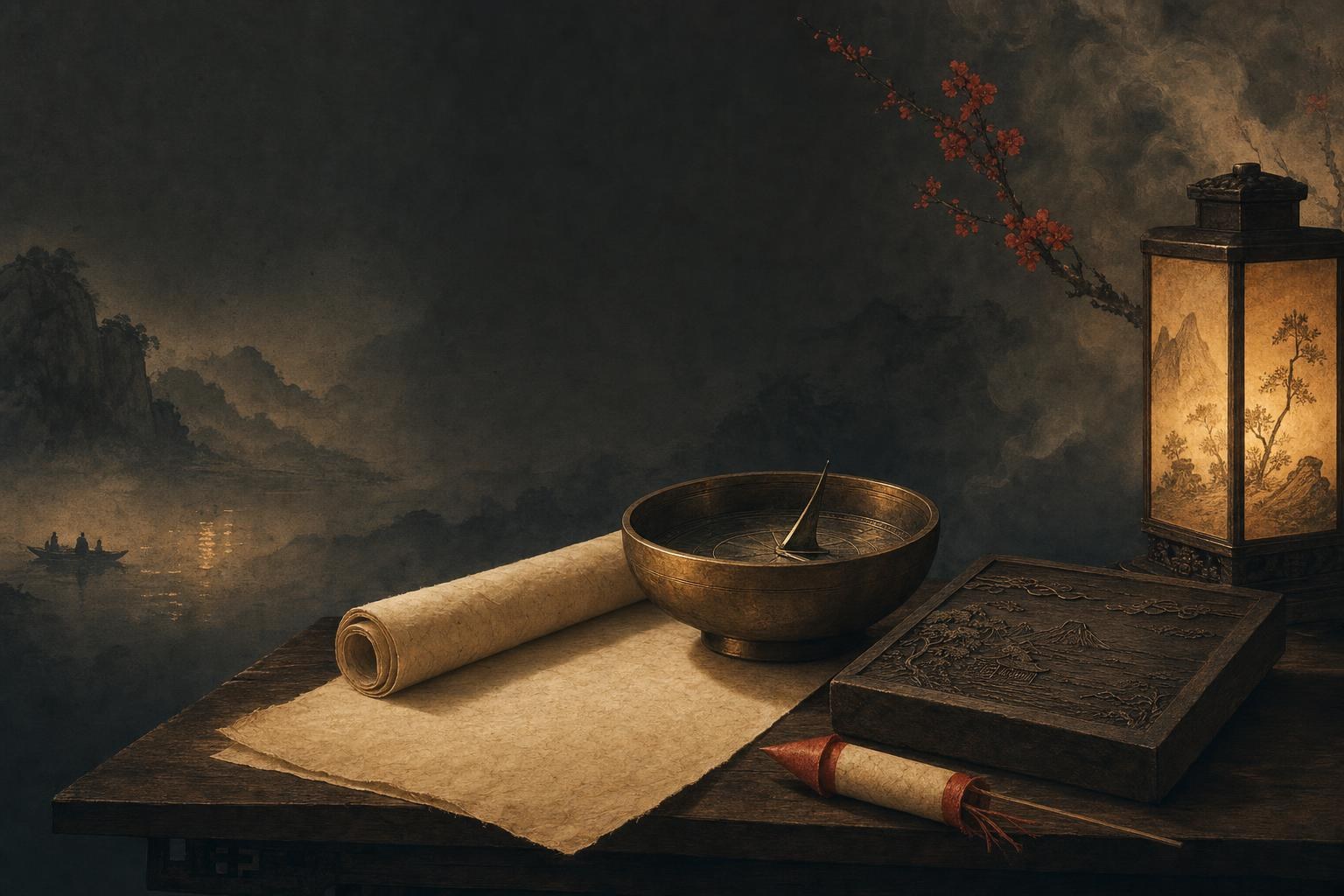
The most famous Chinese inventions are the "Four Great Inventions" (四大发明, sì dà fāmíng): paper (造纸术, zàozhǐshù, "papermaking"), printing (印刷术, yìnshuāshù), gunpowder (火药, huǒyào), and the compass (指南针, zhǐnánzhēn). Those four alone changed how the whole world writes, reads, fights, and finds its way.
But China invented a lot more than four things. Below you'll get the story behind each of the big four, then 20 more ancient Chinese inventions grouped by theme, from silk and porcelain to the toothbrush, the seismograph, and the rocket. Along the way you'll pick up the Chinese words for each one, with pinyin and a link so you can hear them.
The four great inventions of China
The phrase "four great inventions" was made popular by Western historians in the 1800s and early 1900s, and China later adopted it too. Each one has a name, a dynasty, and often a person attached to it.
1. Paper (造纸术)
The Chinese word for paper is 纸 (zhǐ). Papermaking, or 造纸术 (zàozhǐshù), is usually credited to a court official named Cai Lun (蔡伦, Cài Lún) of the Han dynasty (汉朝, Hàncháo), around 105 CE.
Cai Lun's recipe was simple and clever: mash up tree bark, hemp, old rags, and fishing nets in water, spread the pulp on a screen, and let it dry into a thin sheet. Archaeologists have found scraps of earlier paper in China from the century or two before him, so he probably improved and standardized the process rather than starting from zero. Either way, cheap paper spread west along the Silk Road and reached Europe centuries later.
2. Printing (印刷术)
Printing is 印刷 (yìnshuā), and the technology is 印刷术 (yìnshuāshù). It came in two big steps.
- Woodblock printing appeared in the Tang dynasty (唐朝, Tángcháo). A whole page of text was carved backwards into a wooden block, inked, and pressed onto paper. The Diamond Sutra, printed in 868 CE, is the oldest dated printed book we know of.
- Movable type was invented by Bi Sheng (毕昇, Bì Shēng) in the Song dynasty (宋朝, Sòngcháo), in the 1040s. He made individual characters out of baked clay, arranged them in a frame, printed, and then reused them. That's around 400 years before Gutenberg's press in Europe.
3. Gunpowder (火药)
火药 (huǒyào) literally means "fire medicine," and that name tells the story. Tang-era alchemists in the 9th century were mixing saltpeter, sulfur, and charcoal while searching for an elixir of immortality. Instead of eternal life, they got a powder that flashed and burned.
At first it was used for fireworks (烟花, yānhuā) and firecrackers, which are still set off every Chinese New Year to scare away bad luck. By the Song dynasty it was packed into fire arrows, bombs, and early guns. Gunpowder reached the Middle East and Europe by the 1200s and 1300s and rewrote warfare everywhere.
4. The compass (指南针)
The compass is 指南针 (zhǐnánzhēn), literally the "south-pointing needle." Chinese compasses point south by convention, not north, though of course a needle does both at once.
The earliest version, from the Han dynasty, was a spoon carved from lodestone (a naturally magnetic rock) that spun on a smooth bronze plate. It was used for fortune-telling and for lining up buildings, not for travel. By the Song dynasty, around the 11th century, sailors were using magnetized needles floating in water to steer ships, and the navigational compass was born.
20 more ancient Chinese inventions
People searching for "things invented by the Chinese" usually stop at the big four. Here are more than 20 others, sorted by where you'd meet them. Each one gets its Chinese name and a one-line story.
Everyday life
- Silk, 丝绸 (sīchóu). Silk-making goes back over 4,000 years. Legend credits the empress Leizu (嫘祖, Léizǔ) with discovering that a cocoon could be unwound into thread. China guarded the secret for centuries, and the trade route named after it, the Silk Road, carried most of the other inventions on this list westward.
- Porcelain, 瓷器 (cíqì). Fine, white, glassy ceramics fired at very high temperatures were perfected by the Tang and Song dynasties. Europeans couldn't copy it for hundreds of years, which is why English still calls dishes "china."
- Paper money, 纸币 (zhǐbì). Song dynasty merchants in Sichuan were tired of hauling heavy strings of coins, so around the early 1000s they started using printed notes called jiaozi (交子, jiāozǐ). The government soon took over and issued the world's first official paper currency.
- The umbrella, 伞 (sǎn). Collapsible umbrellas made of oiled paper over a bamboo frame appear in Chinese records well over 2,000 years ago, used for both rain and sun.
- The kite, 风筝 (fēngzheng). Kites were flying in China by around the 5th century BCE. They were used to measure distances, send signals in war, and simply for fun.
- The bristle toothbrush, 牙刷 (yáshuā). The first toothbrush with bristles (hog hair set into a bone or bamboo handle) is recorded in Ming dynasty (明朝, Míngcháo) China, in 1498.
- Toilet paper, 卫生纸 (wèishēngzhǐ). Once you have cheap paper, someone will find this use for it. Chinese texts mention it by the 6th century, and by the Ming dynasty the imperial court was ordering it by the hundreds of thousands of sheets.
- Playing cards, 纸牌 (zhǐpái). Card games appear in Tang dynasty records, around the 9th century, making them another gift of paper and printing. Cards traveled west through Persia and Egypt to Europe.
- Lacquer, 漆 (qī). Sap from the lacquer tree, painted on in dozens of thin coats, gives wood a hard, glossy, waterproof shell. Chinese lacquerware goes back thousands of years and was a luxury export for most of that time.
Science and engineering
- The seismograph, 地动仪 (dìdòngyí). In 132 CE, the scholar Zhang Heng (张衡, Zhāng Héng) built a bronze urn with eight dragon heads around the outside. When an earthquake shook the ground, a ball dropped from one dragon's mouth into a toad below, showing which direction the quake came from.
- The mechanical clock tower, 时钟 (shízhōng, "clock"). In 1092, Su Song (苏颂, Sū Sòng) finished a water-powered astronomical clock tower over 30 feet tall. It used an escapement, the ticking mechanism inside every mechanical clock, centuries before Europe.
- The abacus, 算盘 (suànpán). The bead-on-rod counting frame was in wide use by the Song and Ming dynasties. Skilled users can still beat a calculator on simple sums, and it's the reason "to calculate" in Chinese is 算 (suàn).
- The wheelbarrow, 独轮车 (dúlúnchē, "single-wheel cart"). Chinese wheelbarrows from the Han dynasty put the wheel in the middle, under the load, so one person could push a very heavy cargo. Some even carried sails.
- Cast iron, 铸铁 (zhùtiě). Chinese furnaces were hot enough to melt iron and pour it into molds by around the 5th century BCE. That meant cheap iron pots, tools, and plow blades, more than a thousand years before Europe caught up.
- Deep brine drilling. By the Han dynasty, workers in Sichuan were drilling hundreds of feet down with bamboo pipes and iron bits to reach salty groundwater, then boiling it for salt. Over time the wells reached natural gas, which they piped through bamboo to fuel the boiling. It's the ancestor of modern oil drilling.
Food and drink
- Tea, 茶 (chá). China turned a wild leaf into the world's most popular drink after water. Legend says Emperor Shennong discovered it when leaves blew into his boiling water. We have a whole guide to Chinese tea if you want the full story.
- Noodles, 面条 (miàntiáo). The oldest noodles ever found, made of millet, were dug up in northwest China and are around 4,000 years old. Sorry, Italy.
- Chopsticks, 筷子 (kuàizi). Chopsticks started out as cooking tools for reaching into hot pots, at least 3,000 years ago, and became everyday eating utensils by around the Han dynasty.
- Acupuncture, 针灸 (zhēnjiǔ). Fine needles placed at specific points on the body have been part of Chinese medicine for over 2,000 years. The earliest detailed text on it dates to the Han dynasty.
War
- The crossbow, 弩 (nǔ). Chinese armies were using crossbows with precise bronze trigger mechanisms by the Warring States period (around the 4th century BCE). The Terracotta Army was buried with thousands of them.
- The stirrup, 马镫 (mǎdèng). The full two-sided riding stirrup shows up in Chinese tombs by around the 4th century CE. It let a rider stay seated while swinging a weapon, and it changed cavalry warfare across Asia and Europe.
- The rocket, 火箭 (huǒjiàn, "fire arrow"). Once you have gunpowder, you can strap a tube of it to an arrow. Song dynasty soldiers were firing rocket-propelled arrows by the 1200s. The same word, 火箭, is used today for the rockets that launch satellites.
- The fishing reel. A spinning reel for winding in fishing line appears in Chinese paintings from around the 12th century, several hundred years before it turns up in Europe. Not a weapon, but it fits nicely at the end of a list that started with a needle floating in water.
What did China invent that you use today?
A surprising amount of your daily routine runs on early China inventions. A few examples:
- Paper: every notebook, book, receipt, and cardboard box.
- The compass: your phone has a tiny magnetometer inside it, which is how the map knows which way you're facing.
- Fireworks: every 4th of July and New Year's Eve show is gunpowder doing its original job.
- Tea: iced, hot, bubble, or matcha, it all started as 茶.
- Noodles: ramen, pho, and yes, spaghetti's older cousin.
- Playing cards: poker night, solitaire on your laptop, and trading card games.
- The toothbrush: still bristles on a handle, 500 years later.
Inventions like these are one reason Chinese civilization is worth studying alongside the language. If you want the bigger picture, start with our hub on Chinese culture.
The Chinese words for inventions and inventors
If you're going to talk about this topic in Chinese, a handful of words will carry you a long way.
- 发明 (fāmíng): "invention" or "to invent." It's both the noun and the verb, so 中国发明了纸 (Zhōngguó fāmíng le zhǐ) means "China invented paper."
- 发明家 (fāmíngjiā): "inventor." The 家 (jiā) ending means "expert" or "specialist," the same way it works in 画家 (huàjiā, "painter").
- 古代 (gǔdài): "ancient times" or "ancient." So "ancient Chinese inventions" is 古代中国的发明 (gǔdài Zhōngguó de fāmíng).
- 中国 (Zhōngguó): "China," literally "middle kingdom."
- 四大发明 (sì dà fāmíng): "the four great inventions." 四 is four, 大 is great, and 发明 you already know.
Here's a fun detail about the character for paper, 纸 (zhǐ). Its left side is the silk radical 纟 (the squeezed form of 丝, sī, "silk"). That's because before paper, the Chinese wrote on strips of bamboo and on silk cloth, and the earliest paper was closely related to silk-making waste. The character remembers that history. If radicals like this are new to you, our guide to Chinese radicals explains how they work.
Want to practice writing these? You can print a sheet for 纸, 火, 药, and 茶 with our free practice sheet tool.
Hear every invention pronounced
A free Chenjin account lets you hear every linked word in this article pronounced by a native voice, save the ones you want as flashcards, and review them with spaced repetition until 火药 and 指南针 stick. You can also read graded stories about Chinese history at your level, with every word tappable.
FAQ
What are the four great inventions of China?
Paper, printing, gunpowder, and the compass. In Chinese they're called 四大发明 (sì dà fāmíng). Paper is credited to Cai Lun around 105 CE, woodblock printing to the Tang dynasty, movable type to Bi Sheng in the 1040s, gunpowder to Tang alchemists in the 9th century, and the navigational compass to the Song dynasty around the 11th century.
Did China invent paper, or did Egypt?
China. Egyptian papyrus is made by pressing strips of the papyrus plant together, so it's closer to a woven mat than to paper. True paper is made from plant fibers broken down into a pulp in water and then dried into a sheet, and that process was developed in Han dynasty China. The English word "paper" comes from "papyrus," which is where the confusion starts.
Did China invent gunpowder?
Yes. Chinese alchemists discovered gunpowder in the 9th century while looking for an elixir of immortality, which is why its Chinese name, 火药 (huǒyào), means "fire medicine." It was used for fireworks first and for weapons within a couple of centuries.
What are the greatest Chinese inventions?
Most historians would put paper and printing at the top, since together they made books cheap and spread knowledge across the world. Gunpowder and the compass come next for their effect on war and exploration. After those, silk, porcelain, paper money, and cast iron each had a huge impact on trade and daily life.
What did ancient China invent that we still use?
Paper, printing, the compass, fireworks, tea, noodles, chopsticks, umbrellas, kites, playing cards, toilet paper, the toothbrush, the wheelbarrow, the abacus, cast iron, and the stirrup are all still in everyday use, mostly in forms an ancient Chinese person would recognize.