

Chinese Dragon: Meaning, Symbolism, and Why It's Nothing Like Western Dragons
 沉浸 TeamAugust 24, 20267 min read
The Chinese dragon, 龙 (lóng), is one of the most misunderstood symbols in the world. In the West, a dragon is a fire-breathing monster that hoards gold and gets slain by a hero. In China, the dragon is the opposite: a wise, benevolent water spirit that brings rain, guards rivers, and stands for power, strength, and good luck. Nobody slays it. People hope to become it.
This guide covers what the Chinese dragon means, where it came from, how it differs from Western dragons, and the everyday Chinese words and idioms it still lives in today.
What does the Chinese dragon symbolize?
Four big ideas, stacked on top of each other over thousands of years:
- Water and rain. The oldest layer. Dragons were believed to live in rivers, lakes, and seas, and to control rainfall. Farmers prayed to the Dragon King (龙王, Lóngwáng) for rain in a drought. That's why Chinese dragons are drawn coiling through clouds and waves, never breathing fire.
- Imperial power. For most of Chinese history, the dragon was the emperor's personal symbol. The emperor sat on the dragon throne, wore dragon robes (龙袍, lóngpáo), and his face was called the "dragon face." A five-clawed dragon was reserved for the emperor alone; nobles got four claws.
- Good fortune and success. The dragon is the luckiest and most prestigious of the twelve zodiac animals. Wishing someone "dragon" qualities means wishing them ambition, talent, and achievement.
- Chinese identity itself. Chinese people sometimes call themselves 龙的传人 (lóng de chuánrén), "descendants of the dragon." The phrase became famous through a hit 1978 song and it's still a shorthand for Chinese heritage.
Chinese dragon vs Western dragon
Same English word, almost nothing else in common. Here's the quick comparison:
- Character: Chinese dragons are benevolent, wise, and lucky. Western dragons are usually greedy, destructive, and evil.
- Element: Chinese dragons control water and rain. Western dragons breathe fire.
- Body: Chinese dragons are long and serpentine, like a snake with legs, and they fly without wings. Western dragons are bulky, lizard-like, and winged.
- Role in stories: In Europe, the hero kills the dragon. In China, the dragon is the goal: the carp that leaps the Dragon Gate becomes one (more on that below).
Eastern dragons across Asia (Japanese and Korean dragons included) descend from the Chinese lóng, which is why they share the serpentine body and the water association. One visible difference: Chinese imperial dragons have five claws, while dragons in Japanese art usually have three.
What does a Chinese dragon look like?
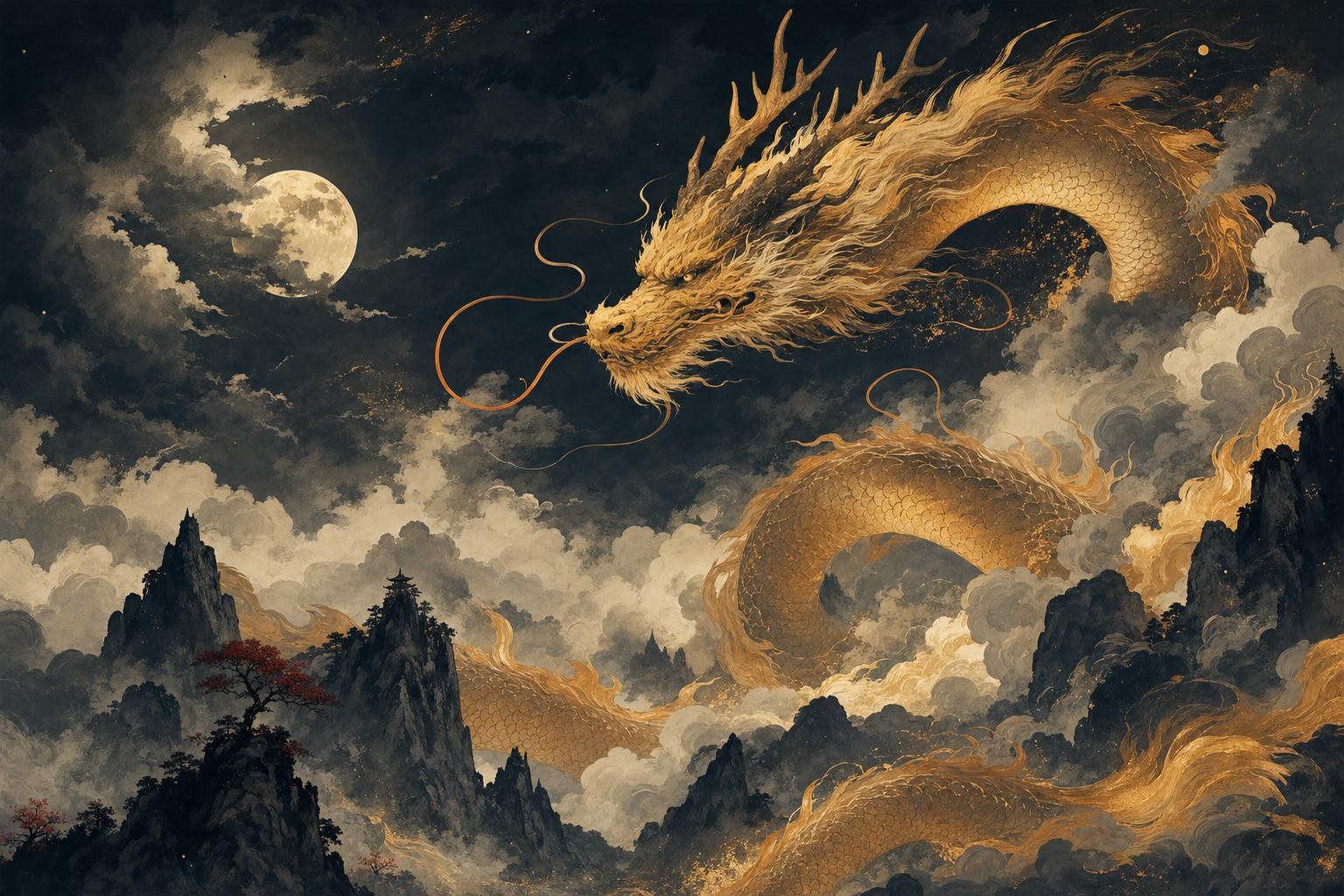
A traditional description, attributed to the Han dynasty scholar Wang Fu, says the dragon combines features of nine animals:
- the antlers of a deer
- the head of a camel
- the eyes of a demon (or a rabbit, depending on the version)
- the neck of a snake
- the belly of a clam
- the scales of a carp
- the claws of an eagle
- the paws of a tiger
- the ears of a cow
Add the flowing whiskers, the flaming pearl it chases through the clouds (usually read as wisdom or thunder), and the long snaking body, and you have the dragon you see on temple roofs, robes, and New Year parades.
A very short history of the Chinese dragon
- Prehistoric China. Jade dragon carvings from the Hongshan culture date back more than 5,000 years, long before Chinese writing. The dragon is older than the characters used to write it.
- Bronze Age. Dragons coil across Shang and Zhou dynasty bronzes, already tied to heaven and water.
- Imperial era. From the Han dynasty on, the dragon fused with the institution of the 皇帝 (huángdì, emperor). Using a five-clawed dragon without permission was a serious crime.
- Astronomy and feng shui. The Azure Dragon (青龙, Qīnglóng) guards the East in the traditional four-symbol sky map, and dragons remain central in 风水 (fēngshuǐ).
- Today. The dragon is everywhere in modern China: dragon dances (舞龙, wǔlóng) at festivals, dragon boat races (龙舟, lóngzhōu) in early summer, and a visible spike in births every dragon year.
The Year of the Dragon
The dragon is the fifth of the twelve zodiac animals and the only mythical one. Recent dragon years are 1988, 2000, 2012, and 2024, and the next one is 2036. People born in a dragon year are stereotyped as confident, ambitious, and a little dramatic.
The dragon's prestige is measurable: hospitals in China and across the Chinese-speaking world reliably report more births in dragon years, because parents want dragon children. The idiom below about "hoping your child becomes a dragon" isn't just a saying, it moves birth rates.
The dragon in the Chinese language
Here's where the dragon gets useful for learners. 龙 (lóng) is an HSK 3 word, and it shows up in everyday vocabulary:
- 龙 (lóng): dragon
- 恐龙 (kǒnglóng): dinosaur, literally "terror dragon"
- 龙舟 (lóngzhōu): dragon boat
- 龙头 (lóngtóu): faucet or tap, literally "dragon head," also the leader in an industry
- 舞龙 (wǔlóng): dragon dance
And it stars in some of the best-known chengyu (four-character idioms):
- 望子成龙 (wàng zǐ chéng lóng): "hoping one's son becomes a dragon," having high hopes for your children
- 画龙点睛 (huà lóng diǎn jīng): "painting the dragon and dotting its eyes," adding the finishing touch that brings something to life
- 卧虎藏龙 (wò hǔ cáng lóng): "crouching tiger, hidden dragon," hidden talent all around you
- 龙飞凤舞 (lóng fēi fèng wǔ): "dragons flying, phoenixes dancing," describes bold, flowing calligraphy (or wild handwriting)
- 叶公好龙 (Yè Gōng hào lóng): "Lord Ye loves dragons," professing to love something you'd run from in real life, from the story of a man who decorated his whole house with dragons and fainted when a real one visited
The dragon is often paired with the phoenix (凤凰, fènghuáng): dragon for the emperor, phoenix for the empress. You'll still see the pair on wedding decorations today. If you want more idioms like these, our chengyu guide and Chinese proverbs collection go deep.
The carp that leaped the Dragon Gate
One dragon legend every learner should know: a carp that swims upstream and manages to leap the waterfall at the Dragon Gate (龙门, Lóngmén) transforms into a dragon. 鲤跃龙门, "the carp leaps the Dragon Gate," became the standard metaphor for succeeding against the odds, and especially for passing a brutal exam. Students hear it around the gaokao every year. It's also why the dragon has carp scales in the nine-animals description above.
How to pronounce 龙 (lóng)
Lóng uses the second tone: a rising pitch, like the way your voice lifts when you ask "huh?" in English. Get the tone wrong and you might land on 弄 (nòng, "to do/handle") or nothing at all. If tones are still fuzzy for you, start with our guide to Chinese tones and the second tone deep dive.
Want to check your own pronunciation? A free Chenjin account lets you hear 龙 spoken by a native-quality voice on its dictionary page and record yourself with Tone Coach, which shows your pitch curve next to the native one so you can see exactly where your rise starts too late.
FAQ: quick answers about the Chinese dragon
Are Chinese dragons good or evil?
Good. Chinese dragons are benevolent symbols of luck, power, and rain. Individual dragon characters in stories can be proud or hot-tempered, but the dragon as a symbol is positive, which is why parents want dragon-year babies.
Why do Chinese dragons have no wings?
They don't need them. Chinese dragons fly by swimming through the air and clouds the way they swim through water. Their power comes from their nature as spirits, not from anatomy.
What is the Chinese dragon's name?
The animal is called 龙 (lóng). It's not one named creature but a whole category of beings, from the four Dragon Kings of the seas to the nine sons of the dragon that decorate temple roofs and bridge posts.
How many claws does a Chinese dragon have?
Imperial dragons have five claws. Four-clawed dragons were used by princes and nobles, and three-clawed dragons are typical in Japanese art. On a Qing dynasty robe, claw count told you exactly who was allowed to wear it.
Is the Chinese dragon the same as the zodiac dragon?
Yes, it's the same creature. The zodiac simply gives the dragon one year in twelve, alongside eleven real animals. Its mythical status is part of why the dragon year is the most popular birth year.
Keep learning
- Chinese culture: values, traditions, and customs explained
- Chengyu: how Chinese four-character idioms work
- 50 Chinese proverbs worth knowing
- Chinese holidays and festivals through the year
- Red envelopes at Chinese New Year
- Chinese tones: the complete guide
- Chinese characters: how the writing system works
- How Chinese names work
- The Chinese zodiac: all 12 animals, elements, and your birth year
- Year of the Dragon: personality, years, and compatibility
- Chinese symbols and their meanings
- 50 interesting facts about China