

Chinese New Year: Dates, Traditions, Dos and Don'ts, and What to Say
 沉浸 TeamSeptember 3, 202616 min read
Chinese New Year is the biggest holiday of the year in China and across much of Asia, and the next one lands on Saturday, February 6, 2027, the start of the Year of the Goat. In Chinese it's called 春节 (Chūnjié, "Spring Festival"), and celebrating it is simply 过年 (guònián, "to pass the year").
The holiday isn't a single day. It kicks off with New Year's Eve, 除夕 (Chúxī), and runs for 15 days until the Lantern Festival, 元宵节 (Yuánxiāojié). This guide covers the dates, the traditions day by day, the food and what it means, the dos and don'ts, the greetings you'll want to say, and the symbols you'll see everywhere. If you want the bigger picture of Chinese holidays and customs, start with our Chinese culture hub.
When is Chinese New Year?
Chinese New Year moves every year because it follows the traditional Chinese calendar, 农历 (nónglì, "lunar calendar"). That calendar is lunisolar: months follow the moon, but extra "leap months" get added now and then so the year stays lined up with the seasons. The result is that New Year's Day always falls somewhere between late January and late February on the Western calendar.
The holiday begins on the second new moon after the winter solstice. Here are the dates for the next few years, along with the zodiac animal each year belongs to:
- 2026: Tuesday, February 17, 2026, the Year of the Horse
- 2027: Saturday, February 6, 2027, the Year of the Goat
- 2028: Wednesday, January 26, 2028, the Year of the Monkey
Each year takes its animal from a 12-year cycle called the 生肖 (shēngxiào). If you want to know your own animal and what it's said to mean, our Chinese zodiac guide walks through all twelve.
In mainland China, the official public holiday is about a week long, but schools and many businesses close for longer, and the celebrations themselves keep going until the Lantern Festival on the 15th day.
Chinese New Year traditions, day by day
Chinese New Year traditions follow a fairly set rhythm. Here's what happens, roughly in order, from the week before the holiday to the day it ends.
Before the new year: cleaning and decorating
In the days before New Year's Eve, families give the house a top-to-bottom clean. The idea is to sweep out the old year's bad luck so there's room for the new year's good luck. The timing matters: you clean before the new year, never on New Year's Day itself (more on that below).
Once the house is clean, it gets decorated in red. The two decorations you'll see on almost every door:
- 春联 (chūnlián, "spring couplets"): two matching lines of poetry written in black or gold on long strips of red paper, pasted on either side of the door, with a shorter strip across the top.
- 福 (fú, "good fortune"): a single character on a red diamond. You'll often see it hung upside down. That's on purpose: "upside down" is 倒 (dào), which sounds like 到 (dào, "to arrive"), so an upside-down 福 means 福到 (fú dào), "luck has arrived."
Many families also buy new clothes for the holiday, ideally something red, and get a haircut before the new year starts.
New Year's Eve (除夕): the reunion dinner
New Year's Eve is the most important night of the whole holiday. Everyone travels home for the 年夜饭 (niányèfàn, "reunion dinner"), a big family meal that's the emotional center of the festival. The trip home is part of the tradition too: the travel rush is called 春运 (chūnyùn), and it's often described as the largest annual human migration on Earth, with billions of trips made in the weeks around the holiday.
After dinner, families stay up late together, a custom called 守岁 (shǒusuì, "keeping watch over the year"). In many homes the TV is tuned to the CCTV New Year's Gala, a variety show that's been running since the 1980s. At midnight, the noise starts.
Firecrackers, fireworks, and the 年 monster
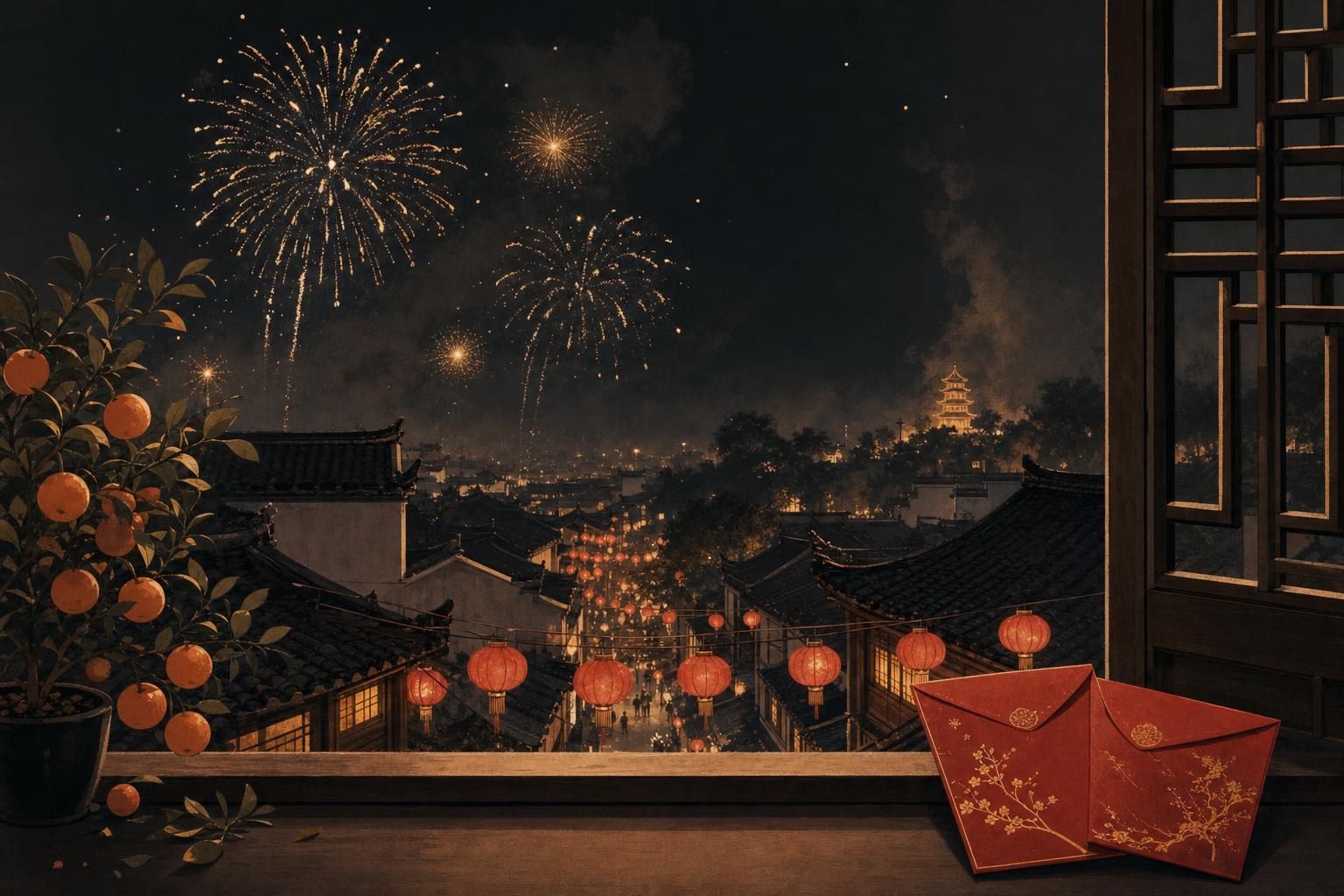
Firecrackers, 鞭炮 (biānpào), and fireworks, 烟花 (yānhuā), go off at midnight and again through the first days of the new year. The old story behind the noise goes like this: a monster called the 年 (Nián) came out of hiding once a year to eat livestock and villagers. People learned that it was afraid of three things, loud noises, bright light, and the color red. So they lit firecrackers, hung red paper, and kept the lamps burning all night. The monster stayed away, and the customs stuck. (Fun detail: 年 is also the ordinary word for "year.")
Many big cities now restrict or ban fireworks for safety and air-quality reasons, so you'll see more electronic firecrackers and light shows than you would have twenty years ago. Smaller towns and the countryside still go all out.
New Year's Day: red envelopes and visiting relatives
On the morning of the first day, kids greet their parents and grandparents with lucky phrases and receive 红包 (hóngbāo, "red envelopes") stuffed with cash. The money inside is called 压岁钱 (yāsuìqián), and it's meant to press down bad luck for the coming year. There's a lot of etiquette here (how much, who gives to whom, which amounts to avoid), so we wrote a separate red envelope guide.
The rest of the first few days are spent on 拜年 (bàinián, "paying New Year visits"): dropping in on relatives, friends, and neighbors, bringing small gifts, and sharing more food. Traditionally the second day is for visiting the wife's side of the family.
Lion dances and dragon dances
Out in the streets and at temple fairs, you'll see the 舞狮 (wǔshī, "lion dance") and the 舞龙 (wǔlóng, "dragon dance"). The lion is two performers under one costume, leaping and blinking to drums and cymbals; the dragon is a long body carried on poles by a whole team. Both are meant to scare off evil spirits and bring good luck to the shops and homes they visit. The dragon is one of the oldest good-luck symbols in China, and we cover its meaning in our Chinese dragon guide.
Day 15: the Lantern Festival
The holiday closes on the 15th day with 元宵节, the Lantern Festival, on the first full moon of the year. Families hang lanterns, solve riddles written on them, watch more lion dances, and eat 汤圆 (tāngyuán), sweet glutinous rice balls in soup. Read more in our Chinese lantern article. After this night, the new year is officially under way.
Chinese New Year food and what it means
Almost every dish on the Chinese New Year table is chosen for a pun. Because so many Chinese words sound alike, a food whose name sounds like "wealth" or "surplus" becomes a way of wishing for those things. Here are the classics:
- 饺子 (jiǎozi, "dumplings"): a northern must-have on New Year's Eve. Folded dumplings look like old gold ingots, so eating them means wealth. Some families hide a coin in one dumpling; whoever bites it gets extra luck.
- 鱼 (yú, "fish"): served whole, head and tail on. 鱼 sounds exactly like 余 (yú, "surplus"), which gives you the greeting 年年有余 (niánnián yǒu yú, "surplus every year"). Many families leave some fish uneaten on purpose so there's literally something left over.
- 年糕 (niángāo, "New Year cake"): a sticky rice cake. 糕 (gāo) sounds like 高 (gāo, "high"), so 年糕 means 年年高 (niánnián gāo), "rising higher every year." Good for grades, salaries, and heights.
- 春卷 (chūnjuǎn, "spring rolls"): golden and cylinder-shaped, so they look like bars of gold.
- 橘子 (júzi, "tangerines") and 橙子 (chéngzi, "oranges"): the words for tangerine and orange sound like "luck" and "success" in some dialects, and their color looks like gold. Bowls of them sit on every table, and they're a standard gift when visiting.
- 汤圆 (tāngyuán): the round shape and the sound of 团圆 (tuányuán, "reunion") make these the food of family togetherness, especially on the Lantern Festival.
- 长寿面 (chángshòumiàn, "longevity noodles"): one extra-long noodle, not cut, slurped without biting through if you can manage it. Long noodle, long life.
- The candy tray: a round box divided into sections, filled with candied fruit, melon seeds, and sweets, set out for guests. Each item carries its own little wish (candied lotus seeds for many children, melon seeds for growth, and so on).
If you're curious about the snacks, seeds, and sweets that show up in that tray, our Chinese snacks guide goes deeper.
Chinese New Year dos and don'ts
A lot of Chinese New Year customs are about not accidentally throwing away the year's luck. Some are taken seriously, some are half a joke, but knowing them helps you avoid an awkward moment at a family gathering. Here are the main ones.
Do
- Clean the house before the new year. Sweep, scrub, and toss out old things in the final days of the old year, not after.
- Wear red. Red clothes, red accessories, even red underwear if it's your zodiac year. Red is the luckiest color in Chinese culture; see our Chinese colors guide.
- Give red envelopes in even amounts. Amounts ending in 8 are best (8 sounds like "get rich"). Avoid anything with a 4, which sounds like "death." Use crisp, new bills.
- Visit and greet elders first. On New Year's Day, the oldest family members get the first greetings and the first visits. That's also when kids collect their envelopes.
- Say lucky phrases. There's a whole list in the next section. Greeting people with a wish for wealth, health, or success is the polite default for the entire 15 days.
- Bring a gift when you visit. Fruit (especially tangerines), tea, sweets, or a nice bottle. Always in pairs or even numbers if you can.
- Settle your debts before the year ends. Starting the new year owing money is considered a bad omen.
Don't
- Don't sweep or take out the trash on New Year's Day. You'd be sweeping the fresh luck right out the door. Many families won't even pick up a broom for the first few days.
- Don't wash your hair on the first day. The word for hair is 头发 (tóufa), and its second character, 发, is the same 发 as in 发财 (fācái, "to get rich"). Washing your hair means washing away your fortune.
- Don't cut your hair during the first lunar month. There's an old superstition that a haircut in the first month brings bad luck to your maternal uncle. Get your trim before the holiday.
- Don't break dishes. Broken plates mean broken luck. If something does shatter, say 岁岁平安 (suìsuì píng'ān, "peace every year"): 岁 (suì, "year") sounds like 碎 (suì, "to shatter"), so the phrase turns the accident into a blessing.
- Don't wear black or white. Both are funeral colors in China. Save the all-black outfit for another week.
- Don't give a clock as a gift. "Giving a clock" is 送钟 (sòng zhōng), which sounds identical to 送终 (sòng zhōng), "to attend a parent's funeral." This one applies all year, not just at New Year.
- Don't give pears, shoes, or sharp objects. Sharing a pear is 分梨 (fēn lí), which sounds like 分离 (fēnlí, "to separate"). Shoes (鞋, xié) sound like 邪 (xié, "evil"). Knives and scissors suggest cutting a relationship.
- Don't cry, argue, or scold children. Whatever mood you set on day one is said to follow you through the year, so families try hard to keep the peace (and kids often get away with a lot).
- Don't lend or borrow money. Lending on New Year's Day means you'll be lending all year; borrowing means you'll be in debt all year.
- Avoid unlucky words. Steer clear of 死 (sǐ, "to die"), 病 (bìng, "sick"), 穷 (qióng, "poor"), and ghost stories. Even the number 4 gets skipped in conversation where possible.
- Don't use scissors or needles on the first day. Sewing and cutting are put away, partly for the "cutting off luck" reason and partly so everyone gets a real day off.
Chinese New Year greetings and sayings
Chinese New Year greetings are mostly four-character wishes. You say them when you arrive at someone's home, when you hand over or receive a red envelope, and in the flood of text messages that goes out on New Year's Eve. Here are the ones you'll hear most, with characters, pinyin, and what they mean.
- 新年快乐 (xīnnián kuàilè): "Happy New Year." The all-purpose greeting. Works for the Western New Year too.
- 恭喜发财 (gōngxǐ fācái): "Congratulations and get rich." The most famous New Year saying of all. If you've heard "Gong hei fat choy," that's the same phrase read in Cantonese; see our article on the difference between Mandarin and Cantonese.
- 万事如意 (wànshì rúyì): "May everything go as you wish."
- 身体健康 (shēntǐ jiànkāng): "Good health." The standard wish for older relatives.
- 年年有余 (niánnián yǒu yú): "Surplus every year." The fish pun from the food section.
- 心想事成 (xīnxiǎng shìchéng): "May your wishes come true."
- 大吉大利 (dàjí dàlì): "Great luck and great profit."
- 步步高升 (bùbù gāoshēng): "Rise step by step." Good for coworkers, bosses, and anyone hoping for a promotion.
- 阖家幸福 (héjiā xìngfú): "Happiness to the whole family."
- 龙马精神 (lóngmǎ jīngshén): "The spirit of a dragon and a horse," meaning energy and vigor. Popular for older people.
- 过年好 (guònián hǎo): "Have a good New Year." A warmer, more everyday greeting, common in northern China.
And the joke reply every kid knows: after someone says 恭喜发财, the cheeky answer is 红包拿来 (hóngbāo nálái), "hand over the red envelope!" Say it with a grin and an open palm.
Most of these are set phrases, so they're worth learning as whole chunks rather than word by word. If you like these, our guides to chengyu and Chinese proverbs are full of similar four-character expressions.
Chinese New Year symbols
You'll spot the same handful of Chinese New Year symbols on decorations, cards, and shop windows every year. Here's what each one stands for.
- Red. The color of luck, joy, and protection (remember the 年 monster). Decorations, clothes, envelopes, and lanterns are all red. Our Chinese colors guide explains why.
- The 福 character. "Good fortune," often hung upside down so that luck "arrives."
- Fish. Surplus and abundance, from the 鱼 / 余 pun. Paper cutouts of fish are a classic window decoration.
- Lanterns, 灯笼 (dēnglong). Red lanterns hang from doorways and along streets for the whole 15 days and star in the final night's festival.
- Firecrackers. Noise that frightens off bad spirits. Even where real ones are banned, you'll see strings of fake red firecrackers hung as decoration.
- Plum blossoms, 梅花 (méihuā). They bloom in late winter, so they stand for perseverance and the promise of spring.
- The zodiac animal. Each year's animal appears on everything from stamps to phone wallpapers. In 2027 that's the goat, 羊 (yáng).
- New Year pictures, 年画 (niánhuà). Colorful woodblock prints of door gods, chubby babies holding fish, and other lucky scenes, pasted up around the house.
- Kumquat trees, 金桔 (jīnjú). Small potted trees loaded with golden fruit. 金 means "gold," and 桔 sounds like 吉 (jí, "lucky"), so a kumquat tree is a tree of golden luck.
- The number 8. 八 (bā) sounds like 发 (fā, "to prosper"), which is why 8s show up in red envelope amounts, prices, and phone numbers. Our guide to Chinese numbers 1-10 covers the lucky and unlucky sounds.
- Gold ingots and coins. The old boat-shaped gold ingot, 元宝 (yuánbǎo), appears on cards and decorations as a straightforward wish for wealth.
For the meanings behind these and other everyday symbols, from the dragon to the double happiness character, see our Chinese symbols guide.
Is it Chinese New Year or Lunar New Year?
Both names are used, and both are fine, but they mean slightly different things. "Chinese New Year" refers to the holiday as celebrated in China and by Chinese communities around the world. "Lunar New Year" is the broader, more inclusive term, because the same date is a major holiday in several other countries:
- Vietnam celebrates Tết, with peach blossoms, kumquat trees, and square sticky-rice cakes.
- Korea celebrates Seollal, with ancestral rites, rice-cake soup, and formal bows to elders.
- Chinese communities in Singapore, Malaysia, Indonesia, the Philippines, and beyond celebrate too, each with local twists (Singapore and Malaysia have a tossed salad called yusheng that's all about "tossing up" good fortune).
So if you're wishing a mixed group of friends well, "Happy Lunar New Year" covers everyone. If you know someone is Chinese, "Happy Chinese New Year" or, better yet, 新年快乐 will land perfectly.
Learn the New Year phrases with sound
Four-character greetings are much easier to remember once you've heard them a few times. A free Chenjin account lets you hear every linked word and phrase in this article pronounced by a native voice, save the ones you want as flashcards so they come back for review before the holiday, and practice your tones on 恭喜发财 with the Tone Coach until it sounds natural.
FAQ
When is Chinese New Year 2027?
Chinese New Year 2027 falls on Saturday, February 6, 2027. It begins the Year of the Goat. New Year's Eve is Friday, February 5, and the Lantern Festival that ends the celebrations is on February 20.
How long does Chinese New Year last?
The traditional celebration runs 15 days, from New Year's Eve through the Lantern Festival on the 15th day of the first lunar month. The official public holiday in mainland China is about a week, but many people take longer off, and the travel season stretches over roughly 40 days.
What do you say on Chinese New Year?
The two essentials are 新年快乐 (xīnnián kuàilè, "Happy New Year") and 恭喜发财 (gōngxǐ fācái, "wishing you wealth"). Add 身体健康 (shēntǐ jiànkāng, "good health") for older relatives and 万事如意 (wànshì rúyì, "may everything go your way") for anyone.
What animal is 2027 in the Chinese zodiac?
2027 is the Year of the Goat (sometimes translated as Sheep or Ram). It follows the Year of the Horse in 2026 and comes before the Year of the Monkey in 2028.
What should you not do on Chinese New Year?
On New Year's Day, don't sweep, take out the trash, wash your hair, break anything, argue, lend money, or wear black or white. Avoid giving clocks, pears, shoes, or sharp objects as gifts, and skip unlucky words like 死 (sǐ, "death") and the number 4.
Keep learning
- Chinese holidays and festivals: the full calendar
- Red envelopes (红包): how much to give and how to give it
- The Chinese zodiac: all 12 animals explained
- Year of the Goat
- Chinese lanterns and the Lantern Festival
- Chinese symbols and their meanings
- Chinese snacks you'll find on the New Year table
- Chinese culture: values, customs, and festivals
- Does China celebrate Christmas?