

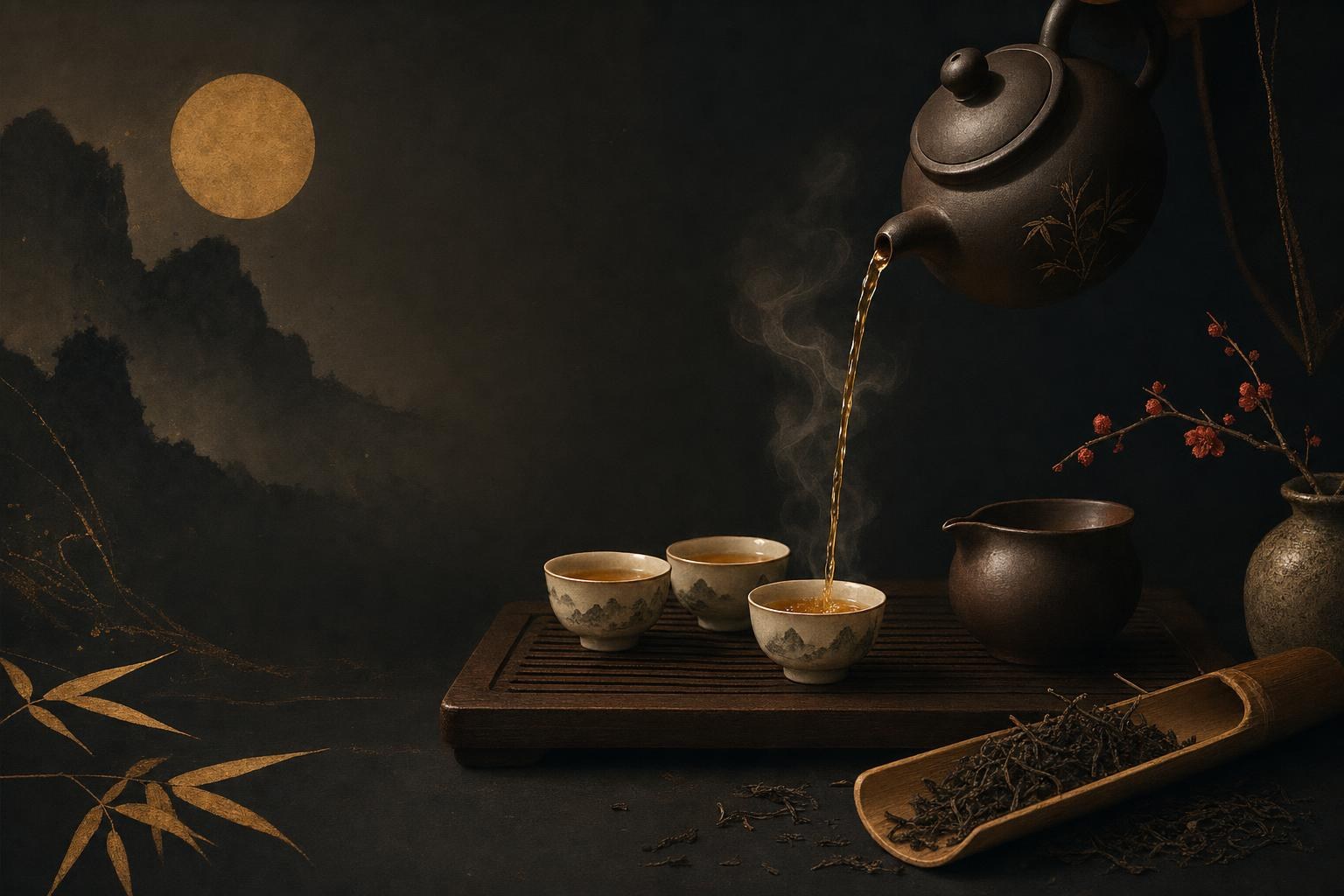
Chinese Tea: Types, Culture, and How to Brew It (With the Words You'll Need)
 沉浸 TeamSeptember 3, 202614 min read
Chinese tea is any drink made from the leaves of the tea plant, Camellia sinensis, the way it has been grown and prepared in China for well over a thousand years. The word is 茶 (chá, "tea"), and nearly every tea in the world traces back to it. There are six main types of Chinese tea, sorted by how much the leaves are allowed to oxidize: green, white, yellow, oolong, black (which China calls "red"), and dark tea like pu'er.
This guide walks through all six types with their Chinese names, explains what "herbal tea" means in China, shows you how to brew Chinese tea at home (gongfu style or the lazy "grandpa" way), and covers the tea culture and manners you'll bump into at a teahouse or a family dinner. Every Chinese word comes with pinyin and a short meaning, so you can read a tea menu or a tea tin by the end.
The six types of Chinese tea
All six types come from the same plant. What changes is what happens to the leaves after picking: how much they're bruised, heated, rolled, and left to oxidize (turn brown, like a cut apple). The less oxidation, the lighter and greener the tea. The more oxidation, the darker and stronger it gets.
Here's a quick map of the six categories before we look at each one:
- 绿茶 (lǜchá, "green tea"): no oxidation
- 白茶 (báichá, "white tea"): very light oxidation
- 黄茶 (huángchá, "yellow tea"): light oxidation plus a slow "yellowing" step
- 乌龙茶 (wūlóngchá, "oolong tea"): partial oxidation
- 红茶 (hóngchá, "black tea", literally "red tea"): full oxidation
- 黑茶 (hēichá, "dark tea"): fermented and aged after processing
绿茶 Green tea
Green tea is the most widely drunk tea in China. Fresh leaves are heated soon after picking (pan-fired or steamed) to stop oxidation, so the tea stays green and tastes fresh, grassy, sometimes a little nutty.
Two famous names you'll see everywhere:
- 龙井 (Lóngjǐng, "Dragon Well"): flat, sword-shaped leaves from around Hangzhou, with a smooth, chestnut-like flavor. Often called China's most famous green tea.
- 碧螺春 (Bìluóchūn, "Green Snail Spring"): tiny curled leaves from the Suzhou area, light and fruity with a fresh smell.
白茶 White tea
White tea gets the least handling of any type. The buds and young leaves are simply withered and dried, with no rolling or pan-firing. The result is pale, soft, and sweet, with a light hay or melon taste.
- 白毫银针 (Báiháo Yínzhēn, "Silver Needle"): made only from silvery, fuzzy buds. It's the top grade of white tea.
黄茶 Yellow tea
Yellow tea is the rarest of the six. It's made like green tea, but with an extra step: the warm, damp leaves are wrapped and left to "yellow" slowly, which softens the grassy edge and gives a mellow, slightly sweet cup.
- 君山银针 (Jūnshān Yínzhēn, "Junshan Silver Needle"): straight yellow buds from an island in Dongting Lake, Hunan. Once a tribute tea for emperors.
乌龙茶 Oolong tea
Oolong sits between green and black. The leaves are bruised and oxidized partway (anywhere from lightly to mostly), then roasted. Oolongs can taste like flowers and cream at one end, or toasted caramel at the other. This is the category gongfu brewing was built around.
- 铁观音 (Tiěguānyīn, "Iron Goddess of Mercy"): a rolled, floral oolong from Anxi in Fujian. The lightly roasted style smells like orchids.
- 大红袍 (Dàhóngpáo, "Big Red Robe"): a roasted "rock tea" from the Wuyi Mountains, with a mineral, toasty depth.
红茶 Black tea (called "red tea" in Chinese)
Here's a naming trap. What English speakers call black tea is 红茶 (hóngchá, "red tea") in Chinese, named for the reddish color of the brewed liquid. The leaves are fully oxidized, giving a darker, rounder, often malty or honey-like taste. Chinese black teas tend to be smoother than the strong breakfast teas from India.
- 正山小种 (Zhèngshān Xiǎozhǒng, "Lapsang Souchong"): from the Wuyi Mountains, often smoked over pine wood.
- 祁门 (Qímén, "Keemun"): a black tea from Anhui with a gentle, slightly fruity, cocoa-like flavor.
黑茶 Dark tea and pu'er
Dark tea is the one category where microbes get involved. After processing, the leaves are piled, moistened, and left to ferment, or simply pressed into cakes and aged for years. The flavor is earthy, deep, and smooth. Confusingly, the Chinese name is 黑茶 (hēichá, "black tea"), so "black tea" in Chinese and "black tea" in English are two different things.
- 普洱 (Pǔ'ěr, "pu'er"): from Yunnan, the most famous dark tea. "Raw" pu'er (生普, shēng pǔ) is aged naturally and starts out sharp and green. "Ripe" pu'er (熟普, shú pǔ) is fermented quickly in piles and comes out dark and mellow.
花茶 Scented teas
Scented tea isn't a seventh category, since the base is one of the six above. Tea leaves are layered with fresh flowers so they soak up the smell. The most common is 茉莉花茶 (mòlìhuāchá, "jasmine tea"), usually green tea scented with jasmine blossoms. It's the everyday tea in many northern homes and restaurants. The general word is 花茶 (huāchá, "flower tea").
Chinese herbal tea (凉茶 and friends)
In English, "Chinese herbal tea" covers a big group of drinks that are called 茶 in Chinese but often contain no tea leaves at all. In Chinese, 茶 can mean almost any leaf, flower, root, or grain steeped in hot water. Here are the ones you're most likely to meet:
- 凉茶 (liángchá, "cooling tea"): a bitter herbal drink popular in Guangdong and Hong Kong, made from mixed herbs. People drink it when they feel "heaty," and it's sold in cans and at little street shops.
- 菊花茶 (júhuāchá, "chrysanthemum tea"): dried yellow or white chrysanthemum flowers steeped in hot water. Light and floral, often served with rock sugar.
- 枸杞 (gǒuqǐ, "goji berry"): small red berries dropped into hot water, often together with chrysanthemum.
- 大麦茶 (dàmàichá, "barley tea"): roasted barley grains steeped in water. Toasty and caffeine-free.
So if someone offers you 茶 and it tastes like flowers or toasted grain, nothing went wrong. 茶 is just a wider word than "tea."
How to brew Chinese tea
There are two answers here. The careful way is 功夫茶 (gōngfuchá, "gongfu tea"), which means "tea made with skill and effort." The easy way is what tea drinkers jokingly call "grandpa style." Both are real, and both are used every day in China.
Gongfu style: small pot, lots of short steeps
Gongfu brewing uses a lot of leaf, a little water, and many quick infusions. You'll need one of these:
- 盖碗 (gàiwǎn, "lidded bowl"): a porcelain bowl with a saucer and a lid. It's cheap and works for any tea.
- 紫砂 (zǐshā, "purple clay") pot, often called a Yixing pot after the town that makes them. Serious drinkers keep one pot per type of tea.
The basic steps:
- Warm the gaiwan or pot with hot water, then pour it out.
- Add leaves. Fill about a quarter of the vessel with dry leaf for rolled oolongs, less for fluffy green or white teas.
- Rinse the leaves: pour in hot water and immediately pour it off. This is 洗茶 (xǐ chá, "washing the tea"). Most people skip it for delicate green tea.
- Steep for 5-15 seconds and pour everything out into a small pitcher, then into cups. Never leave water sitting on the leaves.
- Repeat, adding a few seconds each time. A good oolong or pu'er can go 8-12 rounds before it fades.
Water temperature by tea type
Water that's too hot is the number one reason green tea tastes bitter. These are rough ranges, and you'll fine-tune by taste:
- Green tea: around 75-85°C (170-185°F)
- White tea: around 80-85°C (175-185°F)
- Yellow tea: around 80-85°C
- Oolong: around 90-100°C (195-212°F), hotter for roasted styles
- Black (红茶): around 90-95°C (195-205°F)
- Pu'er and dark tea: a full boil, about 100°C (212°F)
No thermometer? Boil the water and let the kettle sit with the lid open for a few minutes before pouring.
Grandpa style: leaves in a glass, done
Walk into any office or train car in China and you'll see it: a tall glass or thermos with leaves floating in it, refilled with hot water all day. Drop a pinch of leaves in a glass, add water that's not quite boiling, and top it up before it runs dry. Green and jasmine tea work best this way, and it's how most people in China drink tea most of the time.
Chinese tea culture
An old saying lists tea as one of the seven daily necessities, alongside firewood, rice, oil, salt, soy sauce, and vinegar. Understanding a few pieces of tea culture goes a long way, and it's a nice doorway into Chinese culture as a whole.
Lu Yu and the Classic of Tea
The first book written entirely about tea was 茶经 (Chá Jīng, "The Classic of Tea"), by 陆羽 (Lù Yǔ) in the 8th century, during the Tang dynasty. It covers where tea grows, how to process it, and how to brew and drink it. Lu Yu is still called the "Sage of Tea."
Tang drinkers boiled powdered tea with salt, Song drinkers whisked it into foam (the ancestor of Japanese matcha), and loose-leaf steeping took over in the Ming dynasty.
Teahouses
The 茶馆 (cháguǎn, "teahouse") has been a public living room for centuries: a place to play cards, hear storytellers, do business, or just sit. In Chengdu, a cup of jasmine tea at a park teahouse buys you a whole afternoon in a bamboo chair. In Guangdong and Hong Kong, the 茶楼 (chálóu, "tea house") is where families go for dim sum on weekend mornings.
Tea manners at the table
A few small habits will make you look like you know what you're doing:
- Pour for others first. Fill the cups of elders and guests before your own.
- Tap two fingers to say thanks. When someone pours your tea, tap your index and middle fingers on the table twice. The story goes that the Qianlong emperor, traveling in disguise, poured tea for his servant, who "bowed" with his fingers so he wouldn't give the emperor away. The gesture is used all over southern China today.
- Lid ajar means refill. At a restaurant, leave the teapot lid tilted open when the pot runs dry.
- Don't fill cups to the brim. A cup that's about 70 percent full is polite.
The Chinese tea ceremony
When people search for "Chinese tea ceremony," they usually mean one of two things. The first is 茶艺 (cháyì, "tea art"): the graceful, practiced way of brewing gongfu tea for guests, with warmed cups, precise pouring, and attention to the smell of the leaves. It's less strict than the Japanese tea ceremony.
The second is the wedding tea ceremony, 敬茶 (jìng chá, "offering tea with respect"). The bride and groom serve tea to their parents and grandparents, calling them by their new family titles for the first time. The elders drink, give blessings, and hand over red envelopes or jewelry. For many families, this is the moment the marriage feels official.
Tea as a gift
Good tea is one of the safest gifts in China. A boxed tin of Longjing or Tieguanyin works for a boss, a teacher, or a partner's parents. If someone gives you tea, it's a sign of respect.
The Tea Horse Road
For about a thousand years, mule caravans carried pressed tea from Yunnan and Sichuan up into Tibet, and brought back horses. The network of mountain trails is called the 茶马古道 (Chámǎ Gǔdào, "Ancient Tea Horse Road"). It's part of why pu'er comes in pressed cakes: they were easier to load on a mule, and they aged on the trip.
Why English says "tea" but Chinese says chá
Almost every word for tea on Earth comes from one of two Chinese pronunciations of the same character 茶. In Mandarin and Cantonese it's chá. In the Min dialect of coastal Fujian, it sounds like te.
Dutch traders bought their tea from Fujian ports in the 1600s and carried the word te across the sea, which is why English has "tea," French has thé, and German has Tee. Countries that got tea by land, along the Silk Road, kept chá: Russian and Hindi chai, Arabic shay, Portuguese chá (the Portuguese traded through Cantonese-speaking Macau). So "tea if by sea, cha if by land" is a pretty good rule. There are more stories like this in our roundup of interesting facts about China.
Chinese tea names and words you'll see on a menu
You've met the big tea names. Here are the everyday words you'll hear in a teahouse, read on packaging, or use with a Chinese friend:
- 茶 (chá, "tea"): the root of everything on this page.
- 喝茶 (hē chá, "to drink tea"): also an invitation. "去喝茶吧" (qù hē chá ba) means "let's go get tea."
- 茶叶 (cháyè, "tea leaves"): the dry leaves you buy in a shop. A tea shop is a 茶叶店 (cháyè diàn).
- 泡茶 (pào chá, "to brew tea"): literally "to soak tea."
- 茶壶 (cháhú, "teapot") and 茶杯 (chábēi, "teacup"): the basic gear. The whole set is 茶具 (chájù, "tea set").
- 茶馆 (cháguǎn, "teahouse"): where you sit and drink.
- 茶点 (chádiǎn, "tea snacks"): the small bites served with tea, like sunflower seeds, dried fruit, or pastries. If snacks are your thing, our guide to Chinese snacks covers a lot more.
- 奶茶 (nǎichá, "milk tea"): tea with milk, including the bubble tea (珍珠奶茶, zhēnzhū nǎichá) sold on every corner.
- 请喝茶 (qǐng hē chá, "please have some tea"): what a host says as they put a cup in front of you. Answer with 谢谢 (xièxie).
- 茶水 (cháshuǐ, "tea water"): what restaurants call the free pot of weak tea they bring to the table.
When you're staring at a tea tin covered in characters you don't know, paste the text into our free Chinese to pinyin converter and it'll give you the pinyin and meanings word by word. Packaging usually lists the type, the origin, and the harvest season.
Hear every tea word out loud
Tea names are full of tricky sounds, like the "ü" in 绿茶 and the third tones in 铁观音. A free Chenjin account lets you hear every linked word on this page pronounced by a native voice, save the ones you want as flashcards for spaced review, and check your own tones with the Tone Coach.
FAQ
What is the most popular Chinese tea?
Green tea is the most widely drunk type in China, and Longjing (Dragon Well) is usually named as the single most famous tea. Jasmine tea is the everyday favorite in the north, oolong rules in Fujian and Guangdong, and pu'er has a devoted following among collectors.
Is Chinese tea healthy?
Plain tea is a low-calorie drink with no sugar, and it contains antioxidants and a moderate amount of caffeine. Traditional Chinese medicine attaches many specific claims to different teas, but those aren't well proven, so enjoy tea for the taste and treat any health benefits as a bonus.
What's the difference between Chinese tea and Japanese tea?
Japanese tea is almost all green tea, usually steamed, which gives it a bright, seaweed-like, umami flavor (think sencha and matcha). Chinese tea covers all six types, and Chinese green teas are usually pan-fired, which makes them toastier and nuttier.
How many times can you steep Chinese tea?
It depends on the tea and how you brew it. Gongfu style with a gaiwan, a good oolong or pu'er gives 8-12 short steeps, and some aged pu'er goes further. Green and white teas usually give 3-5 steeps. In a big mug with one long steep, most teas are done after two or three.
Why is Chinese black tea called red tea?
Chinese names the tea after the color of the liquid in the cup, which is reddish, so fully oxidized tea is 红茶 (hóngchá, "red tea"). English names it after the dark color of the dry leaves. Meanwhile, what Chinese calls 黑茶 (hēichá, "black tea") is the fermented, aged category that includes pu'er.