

Chinese Symbols and Their Meanings: Love, Family, Luck, Strength, and More
 沉浸 TeamSeptember 3, 202613 min read
When people search for Chinese symbols, they usually mean one of two things: a single Chinese character used as a symbol (like 爱 for love or 福 for luck), or a traditional lucky object like a dragon, a red knot, or a pair of mandarin ducks. This guide covers both.
First you'll get the characters searchers ask for most (love, family, strength, life, death, wisdom, luck, and more), each with its pinyin, its meaning, and a note on how it's built. Then you'll get the classic lucky symbols you see on decorations, jewelry, and holiday displays, and a short section on how to write a character correctly so your "symbol" doesn't come out mirrored or garbled. If you'd like the bigger picture behind these ideas, our Chinese culture hub is a good next stop.
Chinese characters used as symbols
A quick note before the list: Chinese doesn't have a separate set of "symbols." These are ordinary words. What makes them feel like symbols is that people write them alone, large, on red paper, on jewelry, or in calligraphy, so a single character carries a whole wish.
Simplified characters are used below, with the traditional form mentioned where it changes the meaning or the look. If you're picking one for a tattoo or a piece of art, read our companion guide on Chinese tattoo words too.
Chinese symbol that means love: 爱 (ài)
爱 (ài, "love") is the character people ask about most. It covers romantic love, love for family, and love for things you enjoy.
The traditional form 愛 has 心 (xīn, "heart") right in the middle, which is why some people prefer it for art. The simplified form 爱 swaps the heart for 友 (yǒu, "friend"). Both are correct; they're just two ways of writing the same word. To use it in a sentence, see how to say "I love you" in Chinese.
Chinese symbol for family: 家 (jiā)
家 (jiā, "family" or "home") is one of the most loved characters in the language. It's built from a roof 宀 (mián, the "roof" radical) over 豕 (shǐ, "pig"). In ancient China a pig under your roof meant you had food, property, and a settled home, so the picture became the word for family.
You'll also see 家庭 (jiātíng, "family" as a household) and 家人 (jiārén, "family members") in everyday speech.
Chinese symbol for strength: 力 (lì) and 强 (qiáng)
There are two good options here, and they mean slightly different things.
- 力 (lì, "strength, power, force"): a simple, old character said to show a flexed arm or a plow. It's the "power" in words like 力量 (lìliàng, "strength, force") and 努力 (nǔlì, "to work hard").
- 强 (qiáng, "strong, powerful"): the adjective. A strong person, a strong team, a strong country. If you want "strong" as a description, this is the one.
Chinese symbol for courage: 勇 (yǒng)
勇 (yǒng, "brave, courageous") has 力 (lì, "strength") at the bottom. The common two-character word is 勇敢 (yǒnggǎn, "brave"), and 勇气 (yǒngqì, "courage") is the noun.
Chinese symbol for life: 生 (shēng)
生 (shēng, "life, to be born, to grow") is a picture of a plant sprouting from the ground. It's everywhere in Chinese: 生活 (shēnghuó, "life, daily living"), 生日 (shēngrì, "birthday"), and 学生 (xuésheng, "student", literally a "learning-life"). 生命 (shēngmìng) is "life" in the sense of being alive.
Chinese symbol for death: 死 (sǐ)
死 (sǐ, "to die, death") is the character for death. You'll rarely see it used as a decorative symbol, for a simple reason: it's considered unlucky to display.
This is also why the number four is avoided. 四 (sì, "four") sounds almost the same as 死 (sǐ), so some buildings skip the fourth floor and people avoid giving gifts in sets of four. The full story is in our guide to Chinese numbers 1-10.
Chinese symbol for wisdom: 智 (zhì) and 慧 (huì)
Wisdom is usually written with two characters together: 智慧 (zhìhuì, "wisdom, intelligence").
- 智 (zhì, "wisdom, wit"): built from 知 (zhī, "to know") over 日 (rì, "sun, day"). Knowledge that is clear as daylight.
- 慧 (huì, "intelligent, wise"): has 心 (xīn, "heart, mind") at the bottom. It leans toward insight and understanding, and it shows up in Buddhist writing a lot.
Chinese symbol for peace: 平安 (píng'ān) and 和 (hé)
平安 (píng'ān, "safe and sound, peaceful") is the wish you'll hear most often: safe travels, a safe year, a peaceful family. It's a common New Year greeting and a popular character pair on pendants.
和 (hé, "harmony, peace, and") is the single-character version, and it's a big idea in Chinese thought: harmony between people, and between people and nature. 和平 (hépíng) is "peace" in the sense of no war.
Chinese symbol for luck and fortune: 福 (fú)
福 (fú, "good fortune, blessing, happiness") is the most displayed character in China. Around Chinese New Year, families paste a red square with 福 on their doors and windows.
Often it's pasted upside down. That's on purpose: "upside-down" is 倒 (dào), which sounds like 到 (dào, "to arrive"). So an upside-down 福 says "good fortune has arrived." It's a pun you can hang on a door.
Chinese symbol for longevity: 寿 (shòu)
寿 (shòu, "long life, longevity") shows up on birthday gifts for older relatives, on peaches (more on that below), and in the phrase 长寿 (chángshòu, "long life"). Together, 福 and 寿 are a classic pair meaning "blessings and a long life."
Double happiness: 囍 (shuāngxǐ)
囍 is the character 喜 (xǐ, "joy, happiness") written twice, side by side. It's read 双喜 (shuāngxǐ, "double happiness") and it's the wedding symbol: you'll see it in red on invitations, decorations, and the door of the newlyweds' home. Two joys, one for each partner.
Chinese symbol for wealth: 财 (cái)
财 (cái, "wealth, money") is half of the famous New Year greeting 恭喜发财 (gōngxǐ fācái, "wishing you prosperity"). The left side is 贝 (bèi, "shell"), because cowrie shells were early money in China.
Chinese symbol for faith and trust: 信 (xìn)
信 (xìn, "trust, faith, letter") is a person (the 亻 form of 人, rén) next to 言 (yán, "speech"). A person standing by their word. It also means "letter" (as in mail), and 相信 (xiāngxìn) is "to believe."
Chinese symbol for dream: 梦 (mèng)
梦 (mèng, "dream") covers both dreams while you sleep and dreams as in goals. 梦想 (mèngxiǎng) is a "dream" you hope to reach. The bottom part is 夕 (xī, "evening"), a nice touch.
Chinese symbol for hope: 希望 (xīwàng)
"Hope" needs two characters: 希望 (xīwàng, "hope, to hope"). The second character, 望 (wàng), means "to gaze into the distance," which is a pretty good picture of hoping. If you want a single character for a design, 望 is the one that carries the meaning.
Chinese symbol for freedom: 自由 (zìyóu)
自由 (zìyóu, "freedom, free") is also a two-character word: 自 (zì, "self") plus 由 (yóu, "from, due to"). Doing things from yourself, by your own choice. There's no single-character shortcut here, so write both.
Chinese symbol for fate and affinity: 缘 (yuán)
缘 (yuán, "fate, affinity, a predestined connection") is one of those words English doesn't have. 缘分 (yuánfèn) is the invisible thread that brings two people together, whether as friends or partners. It's a popular choice for couples' jewelry.
The Way: 道 (dào)
道 (dào, "way, path, road, principle") is the "Dao" in Daoism (Taoism). In daily life it just means road or way, as in 知道 (zhīdào, "to know", literally "to know the way"). As a symbol it stands for the natural order of things, the path you're meant to follow.
Traditional Chinese lucky symbols
Now the second kind of Chinese symbol: objects, animals, and plants that carry a meaning. Many of these work because of puns. Chinese has a lot of words that sound alike, so an animal whose name sounds like "luck" becomes a lucky animal. Others come from old stories or from the way the plant behaves.
Animals
- 龙 (lóng, "dragon"): power, good fortune, and the emperor. Unlike Western dragons, the Chinese dragon brings rain and blessings. Read the full story in our Chinese dragon guide.
- 凤凰 (fènghuáng, "phoenix"): grace, virtue, and the empress. Dragon and phoenix together stand for a married couple, which is why both appear at weddings.
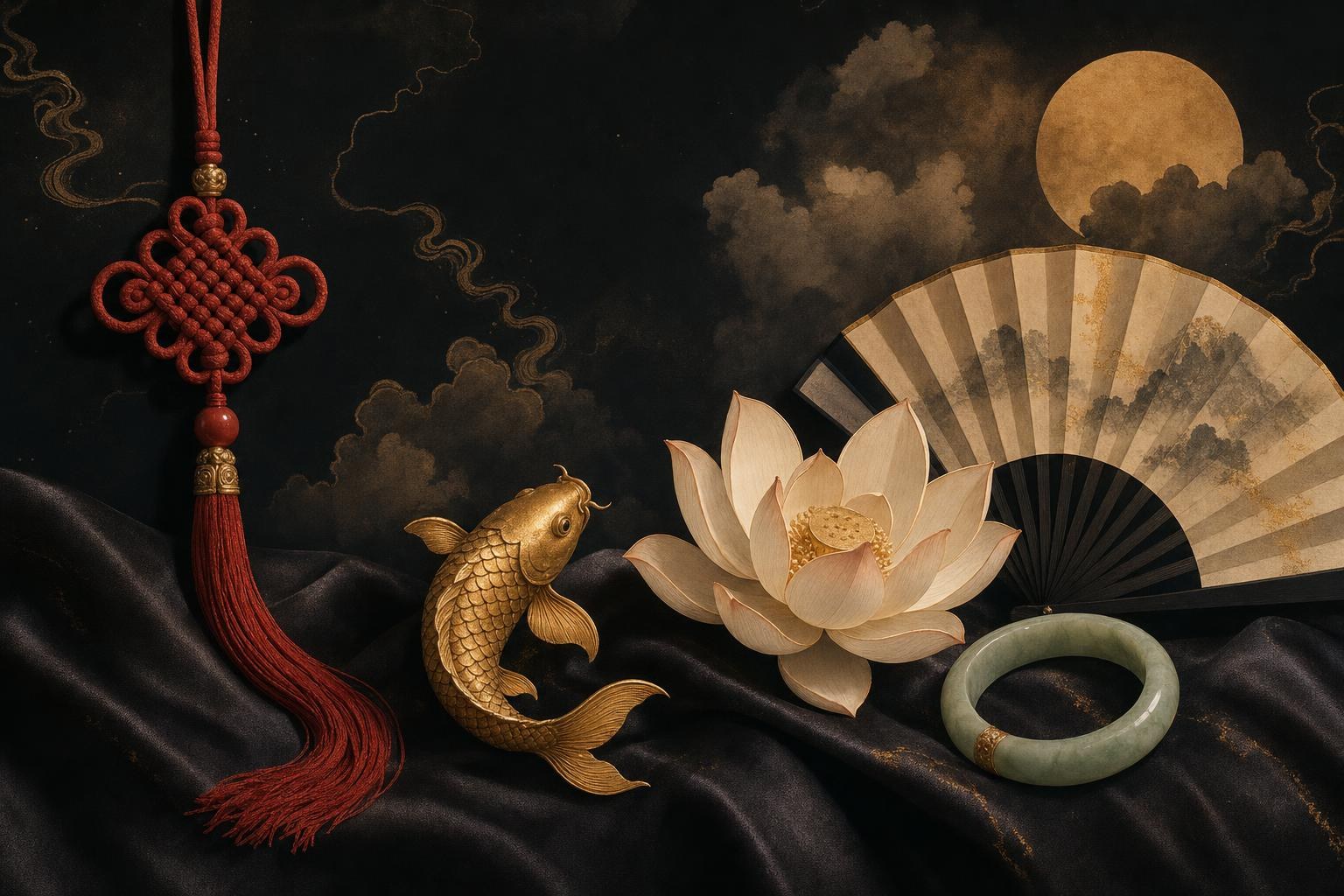
- 鲤鱼 (lǐyú, "carp, koi"): perseverance and success. In an old tale, a carp that swims upstream and leaps the "dragon gate" turns into a dragon. It's a common symbol for passing exams.
- 鹤 (hè, "crane"): long life and wisdom. Cranes are often painted next to pine trees.
- 蝙蝠 (biānfú, "bat"): good luck, because 蝠 (fú) sounds exactly like 福 (fú, "fortune"). Five bats together stand for five blessings.
- 鸳鸯 (yuānyāng, "mandarin ducks"): lasting love. These ducks are believed to pair for life, so they're a wedding and anniversary symbol.
- 麒麟 (qílín, "qilin"): a gentle mythical creature that brings good omens and, in old belief, the birth of talented children.
- 貔貅 (píxiū, "pixiu"): a mythical beast that eats gold and silver and never lets it out. You'll see pixiu figures in shops and on bracelets as a wealth charm.
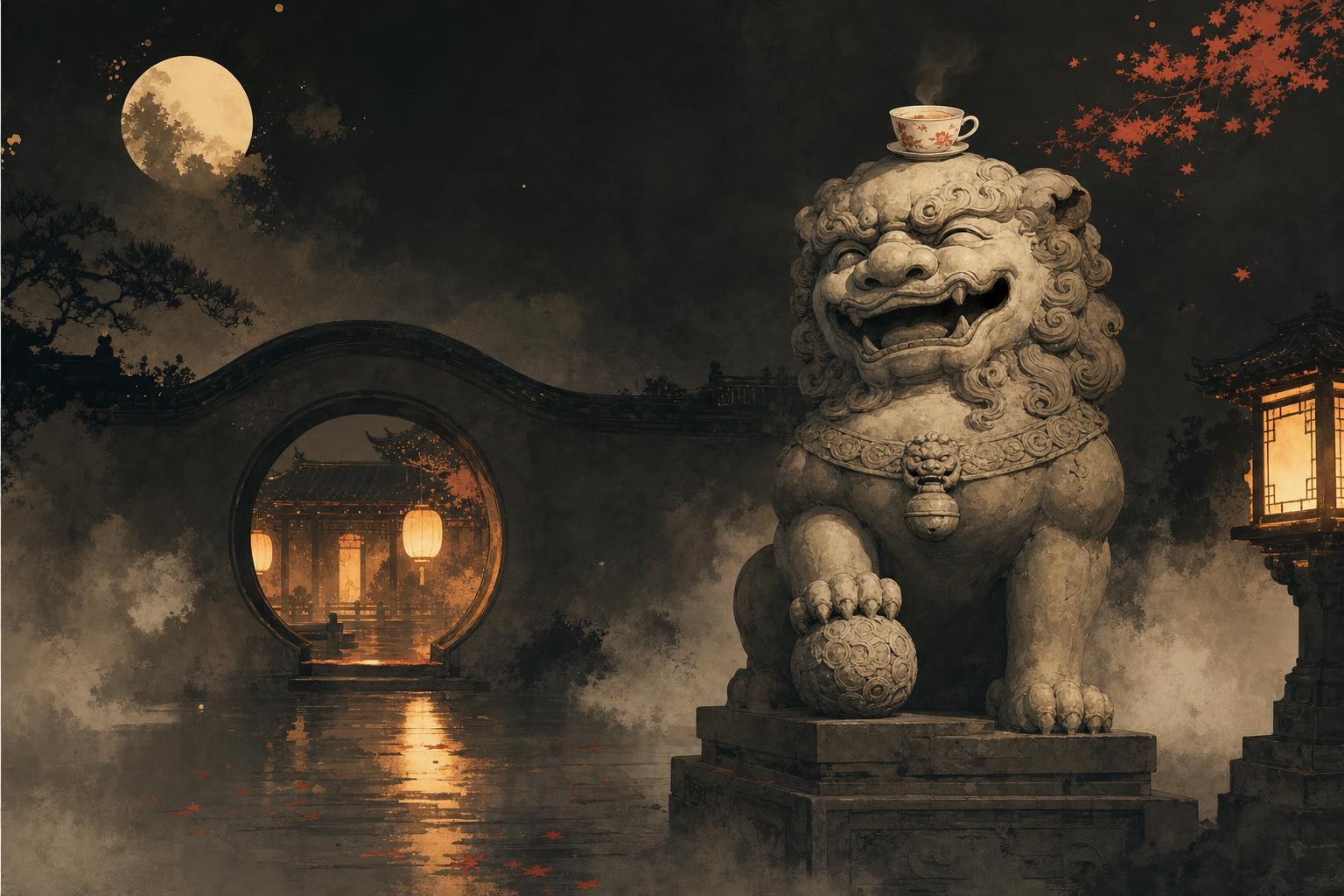
- 狮子 (shīzi, "lion"): protection. The stone lions outside temples, banks, and gates guard the entrance, usually in a pair.
- The twelve zodiac animals: each year has its own animal and personality. Find yours in our Chinese zodiac guide.
Plants
- 莲花 (liánhuā, "lotus"): purity. It grows from mud and rises clean above the water, which is why it's important in Buddhism.
- 竹 (zhú, "bamboo"): strength with flexibility, and integrity. It bends in a storm but doesn't break, and it's hollow, which stands for an open, humble heart.
- 梅花 (méihuā, "plum blossom"): resilience and hope, because it blooms in the cold at the end of winter.
- 松 (sōng, "pine"): long life and steadiness, since it stays green all year. Pine, bamboo, and plum together are called the "three friends of winter."
- 桃 (táo, "peach"): longevity. Peach-shaped buns are served at birthdays for elders, and legend says the peaches of immortality grow in heaven.
Objects and colors
- 中国结 (zhōngguójié, "Chinese knot"): a red cord tied into one continuous knot, a symbol of unity and good luck. It's a classic New Year decoration and car ornament.
- 玉 (yù, "jade"): purity, virtue, and protection. Jade pendants are given to children and passed down in families.
- 铜钱 (tóngqián, "old copper coins"): wealth. The round coin with a square hole represents heaven (round) and earth (square). Coins tied with red string are a common charm.
- 阴阳 (yīnyáng, "yin and yang"): balance. The black-and-white circle is the taiji symbol. Yin is dark, cool, and quiet; yang is bright, warm, and active; each contains a seed of the other.
- 灯笼 (dēnglong, "lantern"): reunion and a bright future. Red lanterns line streets for the New Year and the Lantern Festival. Our Chinese lantern article has the history.
- 红包 (hóngbāo, "red envelope"): good wishes, given with money inside at New Year and weddings. See our red envelope guide for the etiquette.
- The color red: luck, joy, and celebration. It's the color of weddings, New Year, and nearly every symbol on this page. Other colors carry meanings too, covered in Chinese colors and their meanings.
- The number 8: 八 (bā, "eight") sounds like 发 (fā, "to get rich"), so phone numbers, license plates, and addresses with lots of eights are prized.
How to write a Chinese symbol correctly
If you're going to put a character on a wall, a card, or your skin, it's worth getting it right. A few things to check:
- Stroke order matters. Chinese characters are written in a set order (generally top to bottom, left to right), and a character written out of order often looks subtly "off" to a native reader. Our guide to Chinese stroke order explains the rules.
- Pick simplified or traditional on purpose. Mainland China uses simplified characters (爱, 龙); Taiwan and Hong Kong use traditional (愛, 龍). Neither is wrong, but mixing them in one design looks strange. See simplified vs traditional characters to choose.
- Choose a style. Regular script is the clean, printed look. Running and cursive scripts are more flowing and artistic, but harder to read. Our Chinese calligraphy article walks through the main styles.
- Practice before you commit. Print a worksheet for the characters you want and trace them a few times. Here's a ready-made practice sheet for 爱, 福, 家, and 寿 with stroke order shown.
One warning. A lot of "Chinese symbol" decor sold online was made by people who don't read Chinese. Common problems include mirrored characters, characters missing a stroke, random characters that don't mean what the label says, and made-up "symbols" that aren't Chinese at all. If it matters, check the character in a real dictionary (every linked character on this page opens one) or ask a native speaker. For tattoos especially, read Chinese tattoo words before you book.
Hear every symbol pronounced
Knowing what 福 or 缘 looks like is a good start; knowing how to say it is even better. A free Chenjin account lets you hear every linked word on this page pronounced by a native voice, save the ones you like as flashcards, and start reading short graded stories where these characters show up in real sentences.
FAQ
What is the Chinese symbol for love?
The Chinese character for love is 爱 (ài) in simplified Chinese and 愛 in traditional Chinese. The traditional form contains 心 (xīn, "heart") in the middle. Both are correct and mean the same thing.
What Chinese symbol means good luck?
福 (fú) is the main character for good luck, fortune, and blessing. It's the red square pasted on doors at Chinese New Year, often upside down as a pun meaning "luck has arrived." Lucky objects include the dragon, the carp, bats, the Chinese knot, and the number 8.
What is the Chinese symbol for family?
家 (jiā) means family or home. It shows a pig (豕) under a roof (宀), a picture of a settled household. For "family" as a group of relatives, people also say 家庭 (jiātíng) or 家人 (jiārén).
Are Chinese symbols the same as Chinese characters?
Mostly yes. What English speakers call "Chinese symbols" are usually ordinary Chinese characters, which are words, not symbols in the sense of a logo. A character like 爱 is the everyday word "love." The other kind of "symbol," like a dragon or a lotus, is a lucky object or animal with a traditional meaning. Learn how characters work in our Chinese characters guide.
What is the Chinese symbol for strength?
力 (lì) means strength or power and is the simplest choice. 强 (qiáng) means strong as an adjective. For courage, use 勇 (yǒng).
Keep learning
- Chinese culture: values, customs, and festivals
- Chinese tattoo words: what to pick and what to avoid
- The Chinese dragon: meaning and symbolism
- Chinese colors and their meanings
- Chinese numbers 1-10 and their lucky and unlucky sounds
- Chinese New Year: traditions, food, and greetings
- How Chinese characters work
- Chinese calligraphy: styles and how to start
- How to say "I love you" in Chinese
- Beautiful in Chinese: 美, 漂亮, 美丽
- Terms of endearment in Chinese: sweet names for partners and family