Chinese Calligraphy: A Beginner's Guide to the Art of 书法
 沉浸 TeamAugust 24, 20266 min read
Chinese calligraphy, 书法 (shūfǎ, "the way of writing"), is the art of writing Chinese characters with a brush and ink. In China it's not a craft on the sidelines; for most of history it was considered the highest art form, above painting, and a person's handwriting was read as a window into their character. Emperors collected it, scholars trained in it for decades, and one 4th-century drinking party produced the most famous piece of writing in Chinese history.
This beginner's guide covers the tools, the five script styles you'll see everywhere from temple signs to tattoos, a little history, and how to start practicing today with nothing but a pen and a printable grid sheet.
What is Chinese calligraphy?
At its core: writing 汉字 (hànzì, Chinese characters) beautifully, with a flexible brush that records every movement of your hand. Because the brush shows pressure, speed, and hesitation, no two people write a character identically, and that's the point. Calligraphy is valued as a trace of the writer's mind and discipline, the way a signature is, scaled up to an entire art form.
Three things make it work as an art:
- Fixed structure, free execution. Every character has a set stroke order and proportions (the same stroke order rules learners study today). The art lives in how you travel the fixed path.
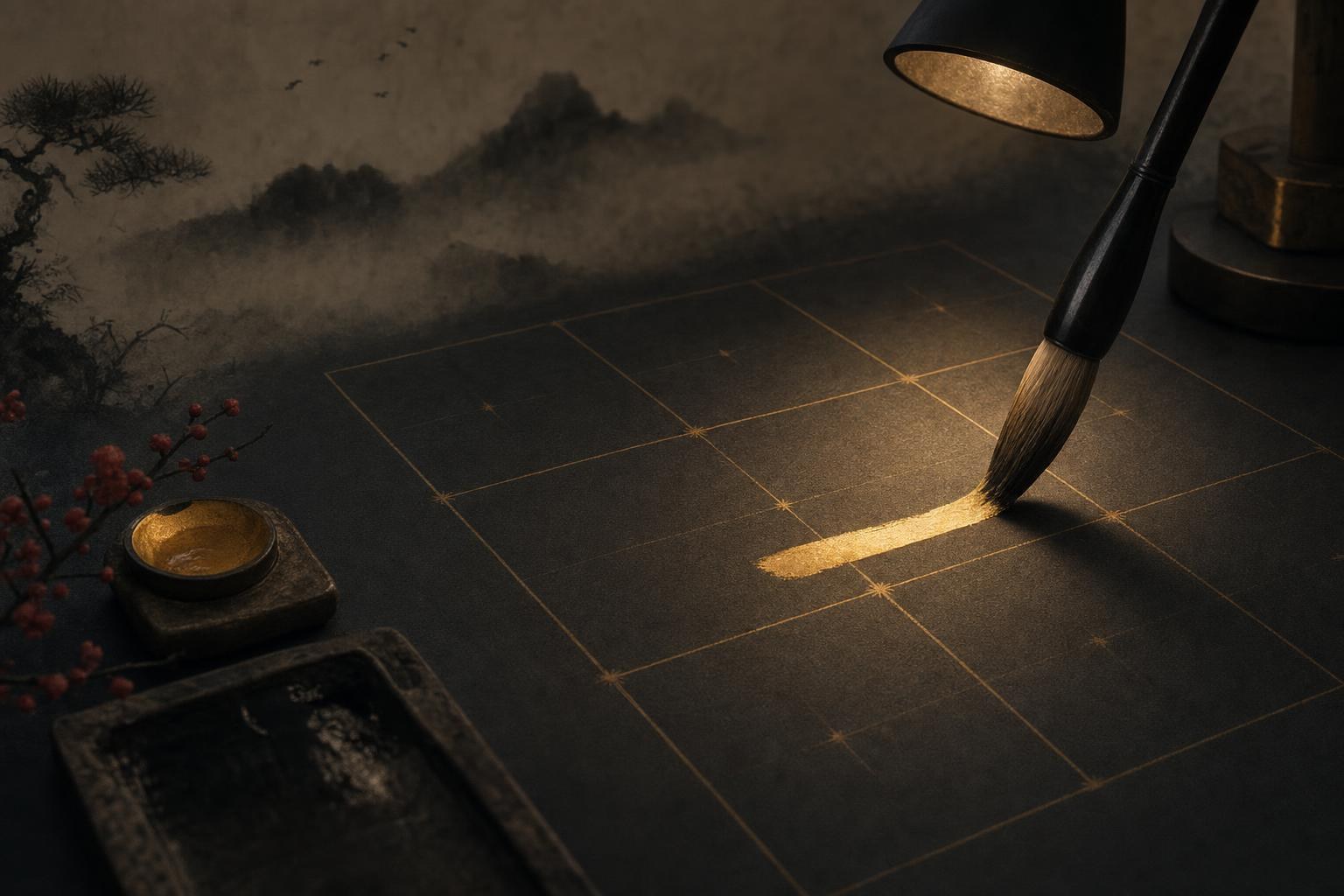
- The brush. A soft, pointed brush can make a line thin as wire or wide as a thumb within one stroke. Pens can't do this, which is why brush writing became the art form.
- Rhythm. A finished piece is judged like a dance: the energy of each stroke, the balance of each character, and the flow of the whole column.
The Four Treasures of the Study
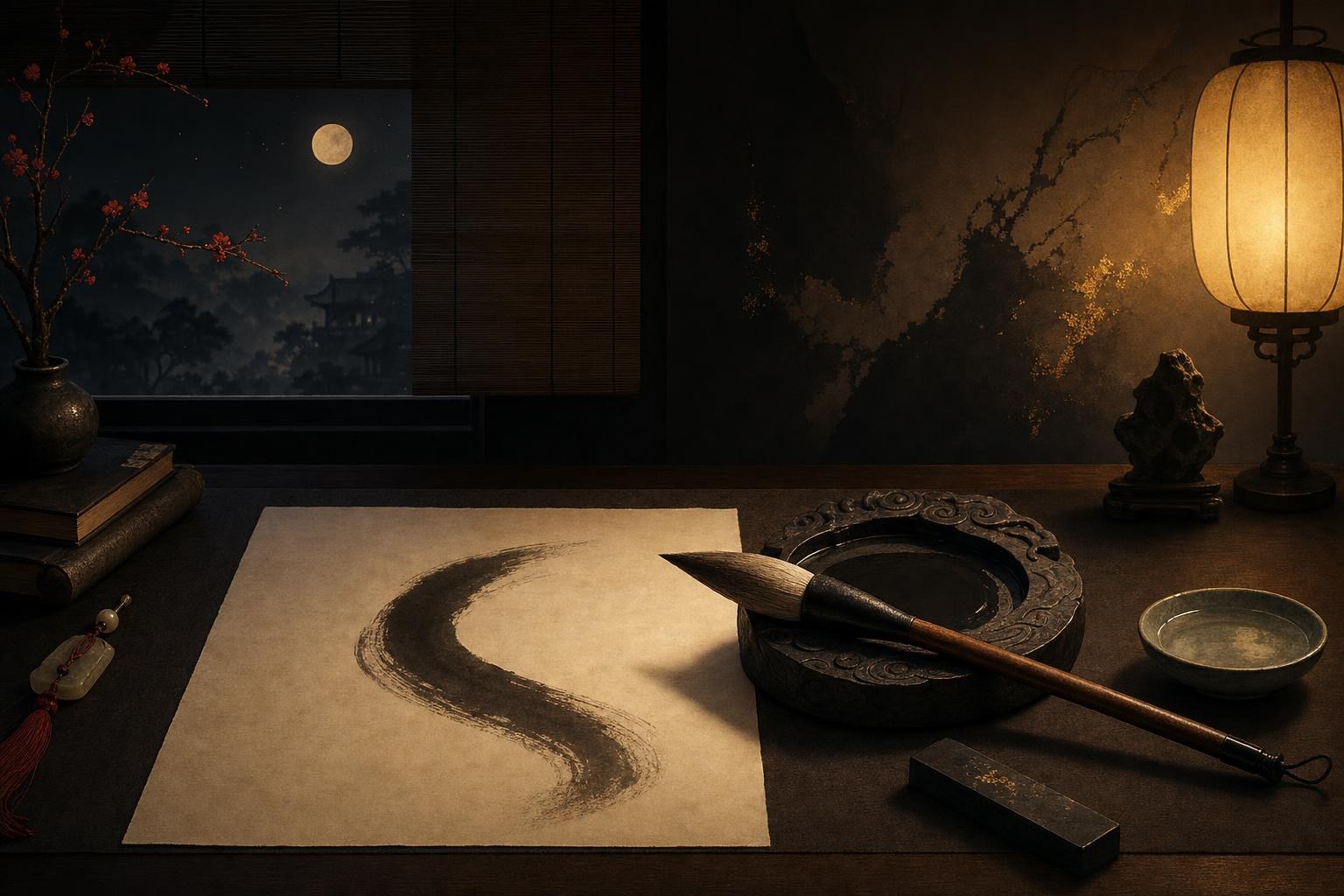
The traditional toolkit is called 文房四宝 (wénfáng sìbǎo), the Four Treasures of the Study:
- 毛笔 (máobǐ): the brush, with a bamboo handle and an animal-hair tip (goat hair is soft, wolf/weasel hair is springy)
- 墨 (mò): ink, traditionally a solid ink stick you grind with water; beginners just use bottled 墨水 (mòshuǐ)
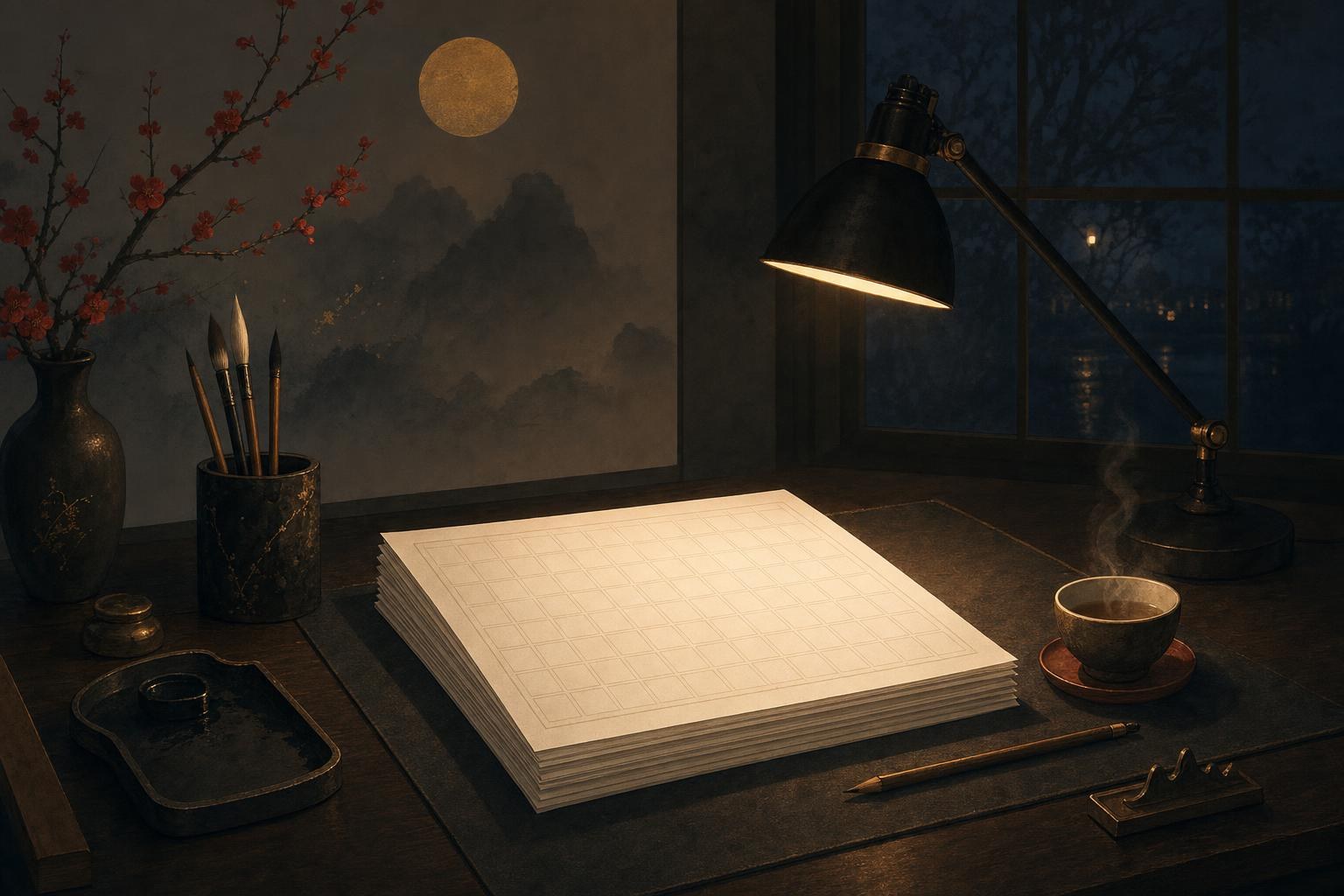
- 纸 (zhǐ): paper, ideally absorbent xuan paper ("rice paper"), which shows every nuance of the ink and forgives nothing
- 砚台 (yàntai): the inkstone, the carved stone dish where ink is ground and held
A starter set of all four costs less than a textbook, and there's an even cheaper option: water-writing cloth that darkens like ink and fades as it dries, so you can drill strokes endlessly with zero mess.
The five script styles
Walk through any museum of Chinese art and you'll see the same text written in wildly different ways. These are the five major scripts, in rough historical order:
- 篆书 (zhuànshū), seal script. The ancient, rounded style descended from bronze and oracle-bone writing. Hard to read today; still used for the red name seals stamped on artwork.
- 隶书 (lìshū), clerical script. The flattened, wide Han dynasty style with wave-like horizontal strokes. The bridge between ancient and modern characters.
- 楷书 (kǎishū), regular script. The clear, upright "textbook" style, and the model for printed characters. Every learner of calligraphy (and of Chinese) starts here.
- 行书 (xíngshū), running script. Regular script written fluidly, with strokes linked for speed. The everyday handwriting of educated adults.
- 草书 (cǎoshū), cursive script. Characters compressed into flowing abstract gestures, sometimes barely legible even to native readers. Pure expression. The chengyu 龙飞凤舞 ("dragons flying, phoenixes dancing") describes exactly this energy.
A little history (and the most famous piece ever written)
Calligraphy matured early. By the Eastern Jin dynasty, the "Sage of Calligraphy" Wang Xizhi (王羲之, 303-361) had set a standard that has never been dethroned. His Preface to the Orchid Pavilion (兰亭序), dashed off half-drunk at a poetry gathering in 353, is the most celebrated work in the history of Chinese writing. The story goes that his sober attempts to rewrite it never matched the original, and the Tang emperor Taizong loved it so much he was buried with it. Every surviving copy is a copy.
For the next 1,500 years, calligraphy sat at the center of education: civil-service examiners judged essays partly on handwriting, and skill with the brush marked you as cultivated. Today it lives on in school classes, park pavements (grandpas writing giant water characters with sponge brushes), New Year couplets on doorways, and a thriving contemporary art scene.
How to start practicing (without a master, or a brush)
You don't need to commit to ink and xuan paper on day one. The skill under calligraphy is stroke order and stroke shape, and you can build both with a pen:
- Learn the stroke order rules. There are only a handful (top to bottom, left to right, horizontal before crossing vertical...). Our stroke order guide covers all of them with animations.
- Practice on the traditional grids. Calligraphy students use 田字格 (field grids) and 米字格 (rice grids), squares with guide lines that teach proportion. Our free character practice sheet generator prints both styles with stroke-order diagrams for any characters you choose, ready for pen or brush.
- Start with the classic first character: 永 (yǒng, "forever"). Tradition says it contains the eight fundamental stroke types, which is why the "Eight Principles of Yong" has been the first calligraphy lesson for over a thousand years. Print a sheet of it and you're practicing the same exercise as a Tang dynasty student.
- Copy, don't invent. Calligraphy is learned by imitating model characters closely (临摹, línmó) for a long time before developing your own hand. It's the one art where copying is the curriculum.
- Then pick up a brush. Once strokes feel automatic with a pen, a cheap brush and water-writing cloth will teach you pressure and speed.
Does calligraphy help you learn Chinese?
Yes, in a specific way: writing characters by hand, slowly and with attention to structure, is one of the strongest memory anchors there is. You stop seeing a character as a picture and start seeing its components, which is exactly the mental shift that makes learning characters scale. You don't need to become an artist; ten mindful minutes of grid practice does more for character memory than an hour of passive review.
If you want the digital half of that loop, a free Chenjin account shows animated stroke order for any character in the dictionary, plus its components and etymology, so you can study a character's structure before you write it.
FAQ
What is Chinese calligraphy called?
书法 (shūfǎ), literally "the method/way of writing." A calligrapher is a 书法家 (shūfǎjiā).
Do I need to know Chinese to try calligraphy?
No. Plenty of people practice calligraphy purely as an art or meditation. But each character you practice comes with a meaning and a pronunciation for free, so most people end up learning some Chinese by accident. Not a bad accident.
What's the difference between Chinese and Japanese calligraphy?
Japanese shodō descends directly from Chinese calligraphy and shares the tools, scripts, and most aesthetics. Japanese calligraphy also writes kana (the Japanese syllabaries) and leans a bit more minimalist in its modern forms.
Is Chinese calligraphy written top to bottom?
Traditionally yes: columns top to bottom, moving right to left. Modern everyday Chinese is written left to right in rows like English, but calligraphy usually keeps the classical layout.
Keep learning
- Chinese stroke order: the rules and why they matter
- Chinese characters: how the writing system works
- Chinese radicals: the components inside every character
- Chinese character practice sheets: how to use them well
- How to draw Chinese characters
- Simplified vs traditional characters
- Chinese culture: values, traditions, and customs
- Chinese tattoo words and meanings
- Chinese inventions: the Four Great Inventions and more