How to Draw Chinese Characters: A Beginner's Handwriting Guide
 沉浸 TeamAugust 14, 20265 min read
Want to draw Chinese characters that look right instead of wobbly? The secret isn't artistic talent. It's three learnable habits: write strokes in the standard order, keep proportions inside a square, and practice on the same grid paper Chinese schoolkids use. This guide walks you through all three, plus a free tool that prints custom practice sheets for any characters you're learning.
(And yes, "draw" is the word many beginners reach for, but you'll graduate to calling it writing soon: characters are handwriting with rules, not freehand art.)
What you need
- A pencil or ballpoint pen. No brush required. Brush calligraphy is a beautiful separate hobby; everyday Chinese is written with whatever's in your backpack.
- Grid paper. Characters are designed to fill a square. Practicing on squares is the single biggest quick win for making your characters look balanced.
- A stroke-order reference. Every Chenjin dictionary page animates its character stroke by stroke, free.
Know the grids: 田字格 and 米字格
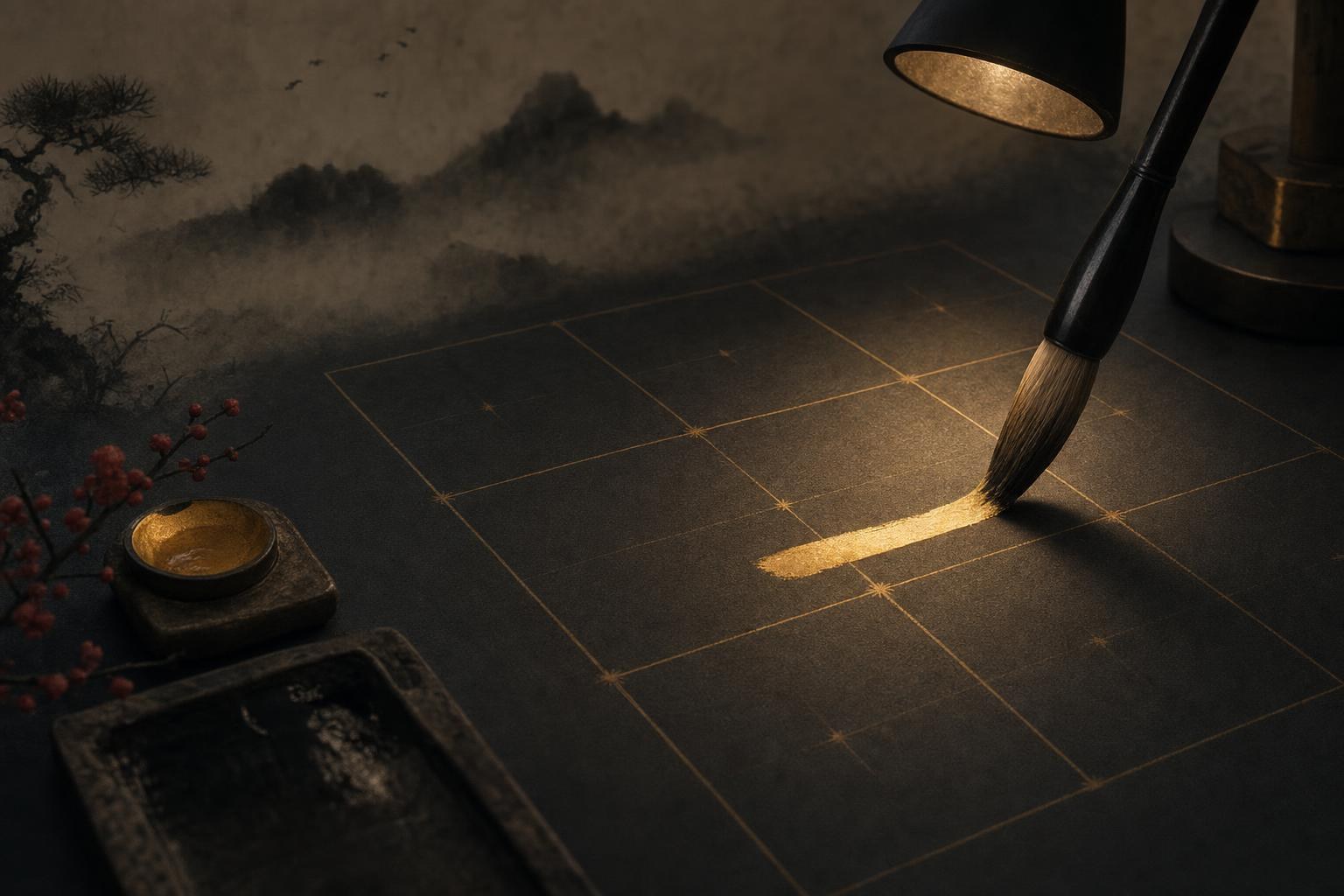
Chinese practice paper isn't plain squares. Each square has light guide lines:
- 田字格 (tiánzìgé, "field grid"): a square split into four quadrants by a vertical and horizontal center line, like the character 田 (tián, field). The guides show you where the character's center is, so components land in the right quadrant.
- 米字格 (mǐzìgé, "rice grid"): the same square with diagonals added, like 米 (mǐ, rice). The extra lines help you angle the sweeping strokes (撇 and 捺) consistently.
Beginners usually do best on 米字格 (more guidance), then move to 田字格, then to plain squares as their proportions internalize. Our free practice sheet generator prints both types, with your choice of characters.
Learn the strokes and their order
Characters are built from a small kit of strokes (horizontal 横, vertical 竖, left-sweep 撇, right-sweep 捺, dot 点, hooks, bends), written in a fixed sequence: top to bottom, left to right, horizontal before vertical, and a few more. About 8 rules cover nearly every character, and they're what make your writing come out balanced and legible. We cover the full set with examples in Chinese Character Stroke Order; skim it once before you practice, then let the numbered diagrams on your practice sheets remind you per character.
Proportion: the part that makes characters look good
Stroke order gets characters correct; proportion gets them handsome. The rules of thumb:
- Fill the square. Beginners write timid little characters floating in the middle of the cell. Stretch out; a character should occupy most of its square.
- Respect component ratios. In left-right characters like 好 (hǎo), the left part is usually narrower (think 1/3 to 1/2 of the width), and side radicals like 亻and 氵stay skinny. In top-bottom characters like 茶 (chá, tea), the top component compresses.
- Keep horizontals level-ish. Native handwriting tilts horizontal strokes up a few degrees, consistently. What kills legibility is randomness, not tilt.
- Center on the guides. That's what the 田/米 lines are for: the character's spine should sit on the vertical center line.
Compare your attempt against the printed model after each repetition and fix one thing at a time: "my 口 is too big," "my sweeps are too flat." One correction per rep beats vague copying.
A 10-minute daily practice routine
- Pick 3 to 5 characters from words you're currently learning, not random ones. Characters you'll meet again stick; see our guide to learning Chinese characters for choosing what to learn.
- Print a sheet for them with the generator: each character gets a numbered stroke-order strip plus rows of empty grid squares.
- Watch the animation once on the character's dictionary page, air-writing along.
- Write each character 5 to 10 times, saying its pronunciation out loud as you write. Sound plus motion is a double memory hook.
- Recall test: at the end, cover the models and write each character once from memory.
Ten focused minutes daily beats an hour on Sunday. Handwriting is muscle memory, and muscle memory compounds with frequency.
Do you even need handwriting anymore?
Honest answer: you can live a full Chinese life typing pinyin and never handwriting a character. But a little writing practice pays for itself even for typers:
- Writing a character a few times is one of the strongest memorization techniques known to learners; it forces you to notice every component instead of recognizing a vague shape.
- It makes similar characters (己/已, 天/夫) stop blurring together.
- It unlocks handwriting input for looking up characters you can't pronounce.
So aim for "can write the characters I'm actively learning," not "can write 3,000 from memory." The second is a calligrapher's goal; the first is a learner's tool.
Frequently asked questions
Is it drawing or writing?
Writing. Characters have a fixed stroke inventory and order, like a very structured cursive. Approaching them as drawings (outlining, sketching, going back to touch up) builds habits that fall apart at writing speed.
Should I start with a brush?
Only if calligraphy itself is your goal. For learning the language, pen and pencil are what natives use daily and what you should practice with. Brush technique adds a whole layer (pressure, entry angles) that's separate from knowing the characters.
What characters should I practice first?
Simple high-frequency ones that double as components: 人, 口, 日, 月, 水, 木, 女, 心. They're the building blocks of hundreds of others; see Chinese Radicals for why.
My characters look uneven. What's the one fix?
Practice on gridded squares and check the center line. Nine times out of ten, "uneven" means components drifting off-center or the character shrinking into a corner, and the grid makes both visible immediately.
Meet characters before you write them: create a free Chenjin account, read stories at your level, and tap any character for its stroke animation, then print it onto a practice sheet.